

If you’ve asked yourself, “Will Social Security run out?” then you’re in good company. It’s a common worry that people bring to a wealth advisor. The short answer is reassuring: Benefits are very likely to continue. However, they may be reduced if Congress doesn’t act before the trust fund is depleted.
Rather than guess at what might happen, we can help you look at the facts, understand the range of possible outcomes, and stress-test your retirement plan against a few scenarios.
A more practical question than “Will Social Security run out?” is “How much of my benefit can I count on?” Focusing on that question can help you plan around what you can control.
What the trust fund is and what “running out” means
Social Security is funded primarily through payroll taxes. The money you and your employer pay goes into two trust funds: the Old-Age and Survivors Insurance (OASI) fund, which pays retirement and survivor benefits, and the Disability Insurance (DI) fund, which pays disability benefits. These funds take in revenue from payroll taxes and pay out benefits to current retirees, survivors, and people with disabilities.
When you hear that Social Security is “running out,” it means that the Social Security Administration (SSA) estimates that these trust fund reserves will be depleted. The question of whether Social Security could run out is more about how much of your scheduled benefit the program can pay.
“Depleted” does not mean “gone.” Payroll taxes keep flowing in, and Social Security continues to pay benefits, just at a reduced level if Congress doesn’t act.
Source: 2026 Social Security Trustees Report
Where things stand in 2026
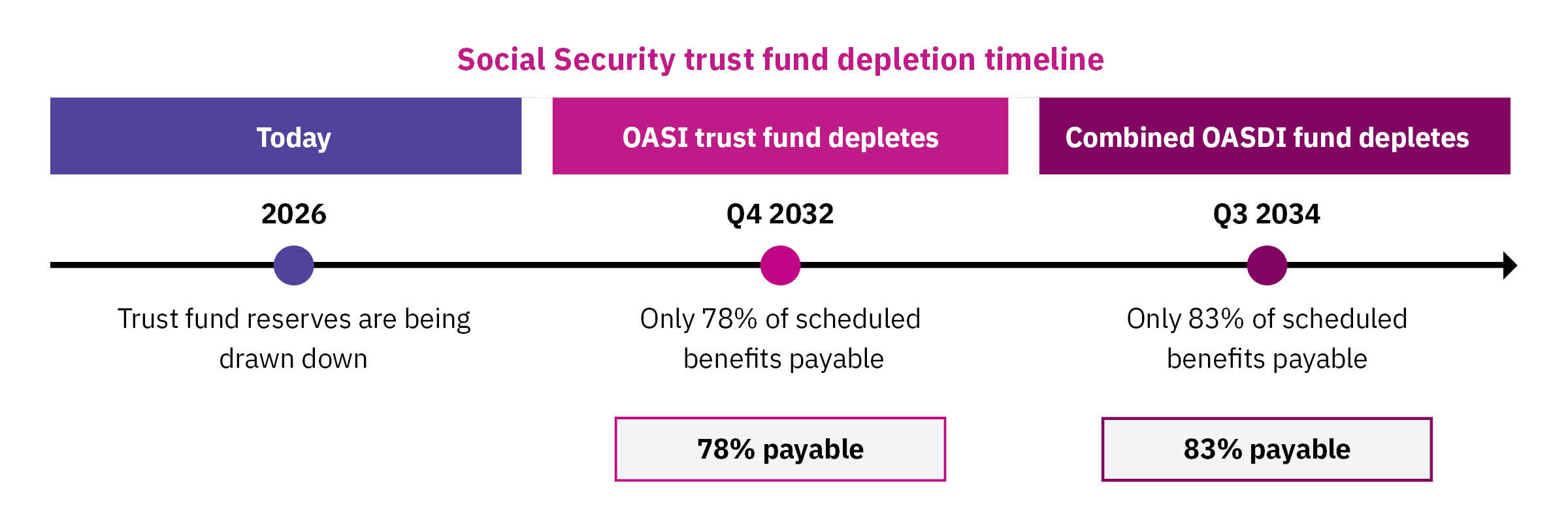
The 2026 Social Security Trustees Report estimates that the OASI fund will be depleted in the fourth quarter of 2032, with roughly 78% of scheduled benefits payable afterward. For anyone asking, “Will Social Security run out?” the 2032 date is the one to watch.1
A 2034 date applies only if Congress legally combines the retirement and disability funds, which would lessen the cut to about 17%, but it wouldn’t fix the shortfall.2
The SSA also confirmed that the 2027 cost-of-living adjustment (COLA) is 3.6%, and the taxable maximum rises to $192,300.3 These annual adjustments reflect wage growth and inflation, rather than the trust fund’s long-term health.
What Congress could do and why that matters for you
Congress has several tools to address the shortfall. Lawmakers could raise the payroll tax cap, adjust the benefit formula, change the full retirement age, or combine the funds. Each option would affect different groups in different ways.
For example, raising the payroll tax cap could affect higher earners. Adjusting the benefit formula might change payouts for future retirees. Raising the full retirement age may affect workers who haven’t retired yet.
The point is that it may not be helpful to guess which option Congress will choose. Outcomes can vary, so a flexible plan generally is preferable to a single guess.
Stress-test your plan: Three scenarios
Here’s where planning becomes practical. Instead of assuming one outcome, consider three potential scenarios for your Social Security benefits:
1. Full benefits: The baseline
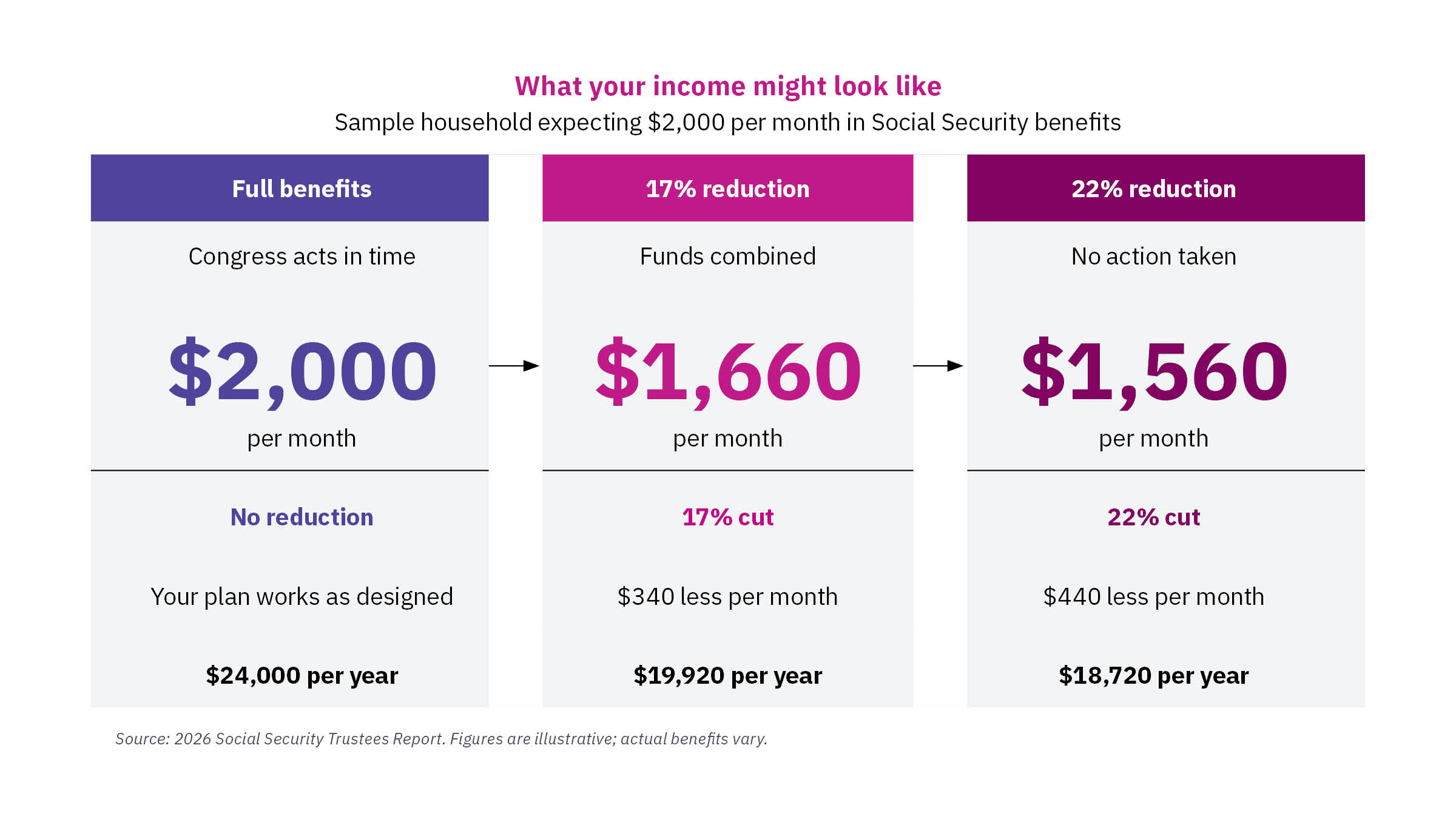
This is a scenario in which Congress acts in time to mitigate depletion and full scheduled benefits continue. Your current plan may work as originally designed.
2. Moderate reduction: About 17%
If Congress combines the retirement and disability funds, the cut lessens to about 17%.4 Your monthly benefit would shrink, but the impact is smaller than with a larger reduction.
3. Larger reduction: About 22% in 2032
If Congress doesn’t take any action, the OASI fund depletes in late 2032 and benefits will drop to about 78% of scheduled amounts, roughly a 22% reduction.5 For someone expecting $2,000 per month, that means receiving about $1,560, a loss of $440 monthly.
What this means for your claiming decision
Some people wonder whether claiming Social Security early could help them avoid a benefit reduction if Social Security runs out of reserves. The answer is no.
A trust fund reduction applies to benefits at every claiming age, so claiming early doesn’t sidestep the risk. In fact, claiming early may lock in a permanently lower benefit before any reduction even takes effect.
The factors to consider for your claiming decision include your health and longevity, your spouse’s age, survivor benefits, other income sources, and taxes.
Moves you can make now
You don’t have to wait for Congress to act. Here are steps you can take today to help you feel more confident in your retirement plan:
- Diversify your income sources. You can help reduce taxable income and optimize retirement planning by building savings across tax-deferred accounts, Roth accounts, and taxable accounts, plus a health savings account (HSA). Different account types are taxed differently, so having options lets you manage your tax picture in retirement.
- Look at retirement tax planning. You may have a lowest-tax window in your early retirement years when your income is temporarily lower. Converting traditional IRA assets to a Roth IRA during that window may provide tax-free income later.
- Consider other income options. Beyond your investment portfolio, you can create steady income that doesn’t depend on Social Security. Options include annuities, such as a qualified longevity annuity contract (QLAC), a bond or CD ladder for predictable near-term income, or dividend-paying investments for a mix of income and growth potential. If you have a pension from a former employer, the choice between a lump sum and lifetime monthly payments can be more meaningful when there may be a reduction in Social Security.
- Review spousal and survivor strategies. If you’re married, the timing of each spouse’s benefits claim can affect both lifetime benefits and what a surviving spouse receives.
- Check your earnings record and benefit estimate. At the SSA’s online portal, my Social Security, you can see your earnings history and estimated benefits to help plan with real numbers, not guesses.
Questions to ask your wealth advisor
A Mercer Advisors wealth advisor can help you put these scenarios in context. Here are a few questions to bring to the conversation:
- What happens to my retirement plan if my Social Security benefit is 20% lower?
- How could a delayed claim change my tax picture?
- Which income sources should I draw from first if benefits are reduced?
- What moves can I make now to reduce my reliance on Social Security?
- How could Social Security benefits affect my overall tax liability, and what are some strategies to reduce the taxation of those benefits?
Making a plan
You don’t have to navigate uncertainty alone. If you’re asking “Will Social Security run out?” and want to stress-test your plan, we can run these scenarios with you and help you build a plan that covers a range of outcomes.
Mercer Advisors offers a unified team of planners, investors, accountants, and estate specialists who design and execute your comprehensive financial plan.

FAQs
-
Social Security faces a long-term funding gap driven by demographic shifts. More retirees are collecting benefits relative to the number of workers paying payroll taxes. Since 2021, program costs have exceeded income, and the trust fund reserves are being drawn down to cover the difference. The 2026 Trustees Report projects that the Old-Age and Survivors Insurance (OASI) fund will be depleted in late 2032 if no legislative changes happen.
-
Claiming early doesn’t avoid a trust fund reduction. A benefit cut would apply at every claiming age, so filing before your full retirement age locks in a permanently lower benefit before any reduction even takes effect. The factors that matter more include your health, longevity, spouse’s age, survivor benefits, other income sources, and taxes. A wealth advisor can help you weigh these factors.
-
It’s worth stress-testing your plan against a few benefit scenarios rather than assuming one outcome. Consider how your plan holds up with full benefits, a moderate reduction of about 17%, and a larger reduction of about 22%. If your plan doesn’t hold up in the lower scenarios, you can adjust your spending, work timing, or withdrawal strategy now to build in more cushion.
-
Building savings across tax-deferred accounts, Roth accounts, and taxable accounts can give you flexibility in retirement. Different account types are taxed differently, so having options lets you manage your tax picture. Adding a health savings account (HSA) and considering income options such as qualified longevity annuity contracts (QLACs) can further diversify your retirement income.
-
You can check your earnings record and estimated benefits through the Social Security Administration’s online portal, my Social Security. The portal shows your earnings history and projected benefits at different claiming ages, so you can plan with real numbers rather than guesses.
-
A wealth advisor at Mercer Advisors can help you stress-test your retirement plan against different Social Security benefit scenarios. Our team can run the numbers with you and help you build a plan that holds up across a range of outcomes. Contact us to arrange a complimentary consultation.
-
The 2032 date applies to the Old-Age and Survivors Insurance (OASI) fund alone, which pays retirement and survivor benefits. At depletion, about 78% of scheduled benefits would be payable. The 2034 date applies only if Congress legally combines the OASI and Disability Insurance (DI) funds, which would extend the timeline but lessen the cut to about 17%. Neither date fixes the underlying shortfall, but combining the funds spreads the reduction across a larger pool.
-
They’re separate reductions that can stack. Claiming before your full retirement age permanently reduces your benefit by up to 30%, depending on how early you claim. A trust fund depletion reduction would apply on top of that, affecting benefits at every claiming age. That’s why claiming early doesn’t avoid the risk of a trust fund cut and may compound the impact on your monthly income
1,2,4,5“The 2026 Annual Report of the Board of Trustees of the Federal Old-Age and Survivors Insurance and Federal Disability Insurance Trust Funds.” Social Security Administration, June 9, 2026.
3“Social Security Announces 3.6 Percent Benefit Increase for 2027.” Social Security Administration, Oct. 14, 2026.
All expressions of opinion reflect the judgment of the author as of the date of publication and are subject to change. Some of the research and ratings shown in this presentation come from third parties that are not affiliated with Mercer Advisors. The information is believed to be accurate but is not guaranteed or warranted by Mercer Advisors. Content, research, tools and stock or option symbols are for educational and illustrative purposes only and do not imply a recommendation or solicitation to buy or sell a particular security or to engage in any particular investment strategy. All investing involves risk, including the possible loss of principal. Hypothetical examples are for illustrative purposes only. The external links are being provided as a convenience and for informational purposes only; they do not constitute an endorsement or an approval by Mercer Advisors of any of the products, services or opinions of the corporations or organizations or individuals represented in the links. Mercer Advisors bears no responsibility for the accuracy, legality or content of the external sites or for that of subsequent links. Contact the external site for answers to questions regarding its content.
For financial planning advice specific to your circumstances, talk to a qualified professional at Mercer Advisors.