

Few decisions in your retirement plan matter more than making sure your income lasts as long as you do. Currently, as soon as you reach age 73 (75 if you were born in 1960 or later), the IRS requires yearly withdrawals from your retirement accounts. These required minimum distributions (RMDs) can push you into a higher tax bracket and draw down your savings faster than you may have planned.
A qualified longevity annuity contract, or QLAC, offers one way to address that challenge. By moving a portion of your retirement account into a deferred-income annuity (a retirement income annuity also called a longevity annuity), you can delay RMDs on that amount until as late as age 85 and create a guaranteed stream of income starting at the same time.
This article explains how QLACs work, how these contracts might fit into your retirement accounts, and whether you might benefit from one.
- Single-life annuities pay for the life of the annuitant and stop at the annuitant’s death.
- Joint-life annuities pay for the longer of two lives and stop at the second death.
- Period-certain annuities pay for a set period, such as 10 or 20 years, usually combined with a single- or joint-life annuity.
- Cash-refund options pay beneficiaries the premium less any income received before the annuitant’s death.
Example
Mike, age 58, buys a deferred-income annuity with $50,000 today. He plans to retire at age 65 and wants income to begin the following month.
He can opt for any of the following options:
- Single-life annuity for approximately $460 per month
- Single-life annuity with a 20-year period certain for $415 per month
- Single-life annuity with a cash-refund option for $440 per month
If Mike is not concerned with leaving behind a death benefit for heirs, the most suitable option is the single-life annuity to receive the highest payout over his lifetime at $460 per month. (Rates can vary.)
Qualified vs. nonqualified annuity
Annuities are classified as qualified or nonqualified depending on where the dollars come from to buy them.
- Qualified annuities are bought with retirement plan dollars, such as from a 401(k), 403(b), 457, or IRA.
- Nonqualified annuities are bought with money from a checking, savings, brokerage, or other nonretirement account.
The main consideration is taxation. The IRS generally taxes payments from a qualified annuity as ordinary income because the money was contributed on a pretax basis. Payments from a nonqualified annuity are only partially taxable. Each payment includes both a return of your original investment (which is nontaxable) and investment earnings (which are taxable). The IRS uses an exclusion ratio to determine how much of each payment is tax-free principal and how much is taxable income.
Qualified longevity annuity contracts
The IRS established the QLAC rules in regulations, most recently updated in July 2024.1 These regulations provide relief from RMDs on the value of a deferred-income annuity that meets the following criteria:
- The annuity begins payouts by the month after the individual turns age 85.
- The annuity provides fixed payouts, although it may have a cost-of-living adjustment.
- The annuity doesn’t have a cash-surrender value, although it may include a cash-refund benefit. A contract may also include a short free-look period letting the owner cancel the contract within 90 days.
- The QLAC limit 2026 is $210,000 in total for each individual, a lifetime cap applied across all of that person’s retirement accounts. A married couple filing jointly can commit up to $420,000 combined because each spouse has an individual limit.
Note that an old 25% account-balance test for an employer retirement plan or traditional IRA was eliminated in the 2024 IRS updates for contracts purchased on or after Dec. 29, 2022, so the only limit now is the dollar cap.
Example
Grant is 60 years old and married. He invests $210,000 in a QLAC that will begin payouts as far into the future as possible, which is when he is age 85. The QLAC rates for his income include the following choices:
- Single-life annuity for $13,000 per month
- Joint-life annuity for $7,500 per month with his spouse
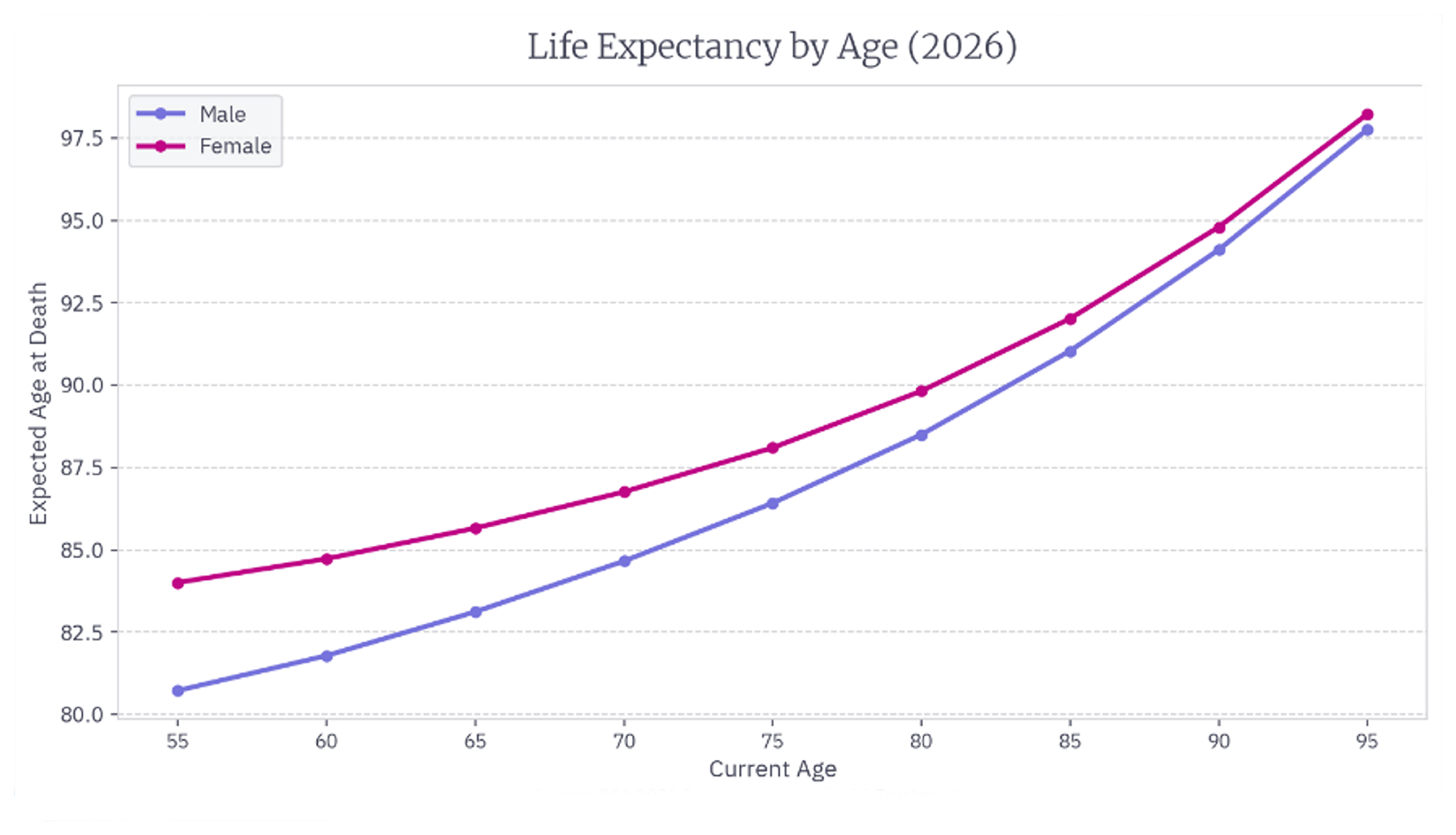
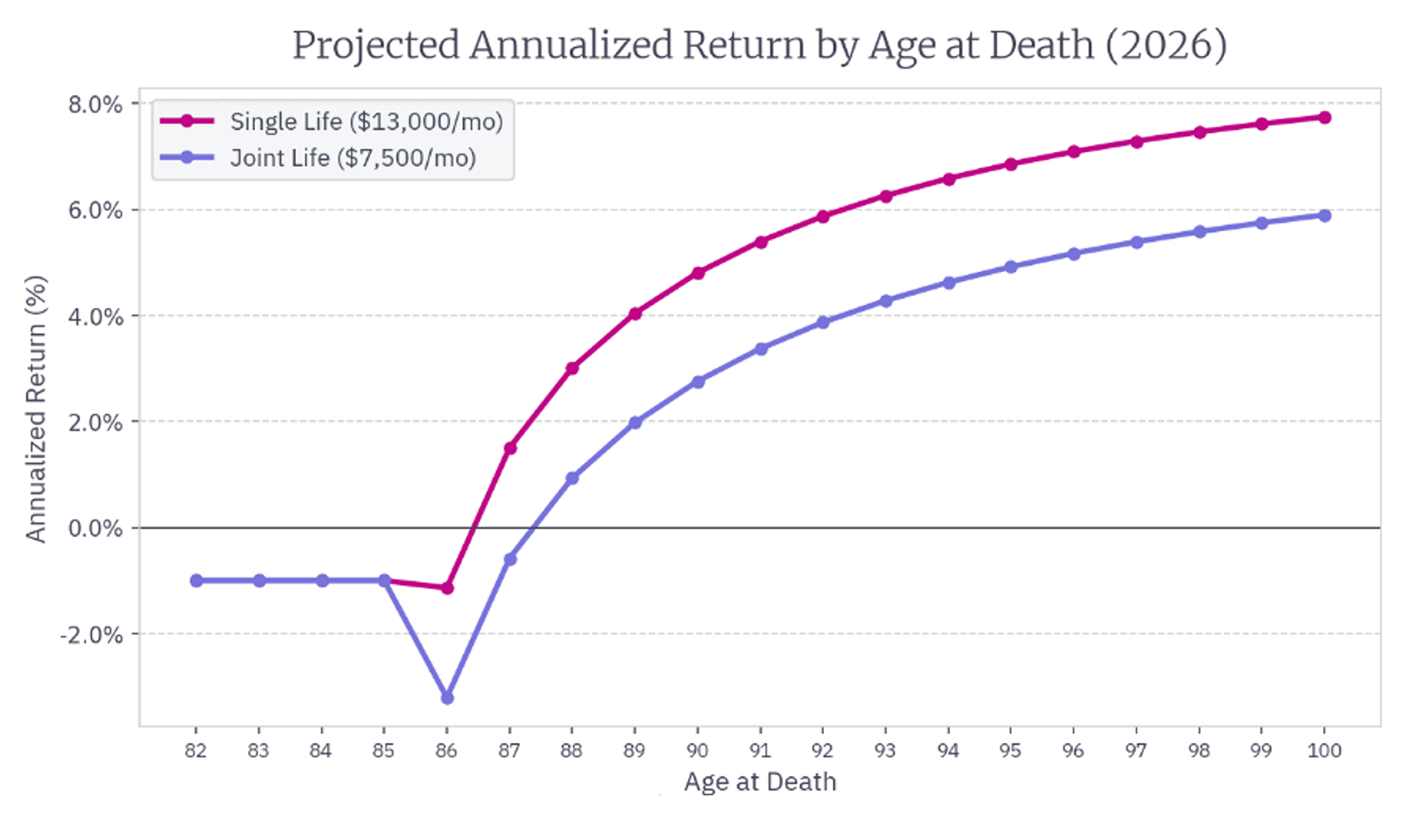
According to the life-expectancy tables, Grant should live to about age 82. His return is negative if he dies before payments begin. At age 85, he breaks even and starts earning a return. By age 95, the implied return is just north of 7% annualized. (Rates can vary.)
If Grant chooses the joint-life annuity at age 60, and he and his wife live to 91, the anticipated return could be around 3.5%. If at least one of them makes it to age 95, the potential return could increase to a little over 5% annualized.
Source: 2026 Trustees Report at ssa.gov.
Source: IRS Notice 2025-67 (2026 QLAC dollar limit). Projections are hypothetical and for illustrative purposes only.



Required minimum distributions
The QLAC RMD deferral means RMDs on that portion are merely deferred, not eliminated. When the owner begins income distributions from the policy, the amounts satisfy the RMDs associated with the annuity only. They cannot be used to offset RMDs associated with other retirement plan assets.
Example
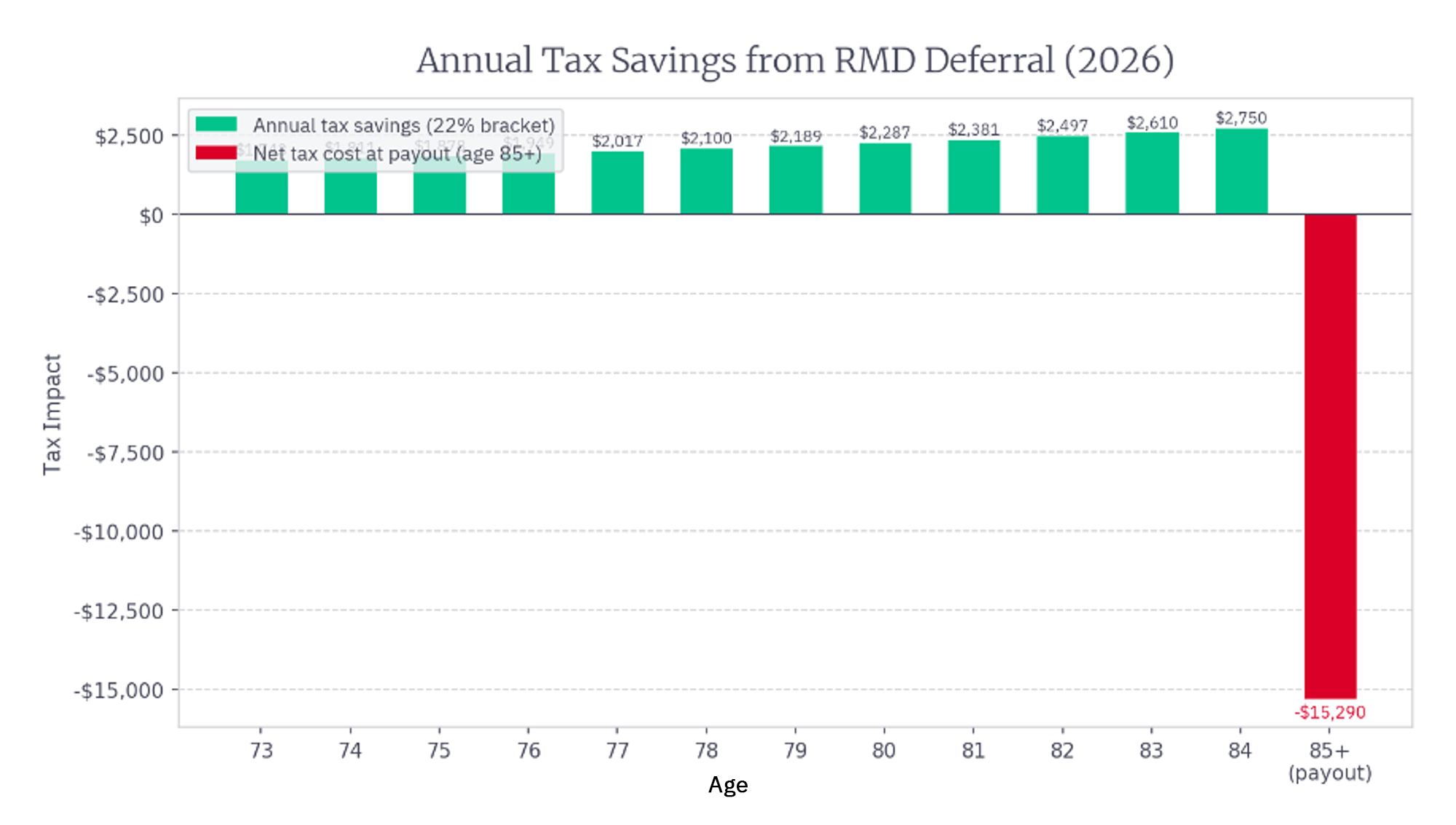
Margaret is age 72 and begins RMDs next year at age 73. She invests $210,000 in a QLAC to reduce her RMDs and defer income until age 85. She is in the 22% federal tax bracket. (For this example, we are ignoring state tax.) The first RMD is reduced by $7,925 ($210,000 divided by 26.5 from the Uniform Lifetime Table), saving about $1,744 in income tax. Over 12 years of deferral, she saves about $26,000 in taxes within the 22% bracket.
The downside comes when the policy begins paying out. Her estimated payout for a single-life annuity is about $82,000 per year. (This is illustrative — obtain a current carrier quote before purchasing a QLAC.) This offsets the RMD she would take at age 85 but not additional distribution requirements. She recognizes about $69,500 more taxable income than standard RMD rules dictate, turning her tax benefit negative by about $15,300 in additional taxes at a 22% rate.
Sources: IRS Notice 2025-67 (2026 QLAC dollar limit) and IRS Publication 590-B, Appendix B. Projections are hypothetical and for illustrative purposes only.
Death of the annuitant
A QLAC purchased with retirement assets provides various results to the beneficiary, depending on the buyer’s elections.
- A single-life income stream ends at the annuitant’s passing. If a balance remains in the accumulation value, most contracts pay it to a beneficiary as the death benefit.
- A joint-life income stream continues, usually to a surviving spouse for life. The 2024 final regulations clarified that a divorce after buying a QLAC — but before payments begin — doesn’t disqualify a joint-and-survivor QLAC, provided a qualified domestic relations order or equivalent instrument meets certain requirements.
- A period-certain option pays any years of the benefit remaining to the beneficiary.
- A cash-refund option pays the difference between the total premium paid and any benefits received. The IRS treats these payments as an RMD in full in the year of receipt, without eligibility for rollover.
Example
Should you buy a QLAC?
Weighing the QLAC pros and cons starts with whether you want a steady stream of income late in life. The trade-off is real: If the owner dies before payments begin, the premium can be lost entirely. That risk is part of the design. High loss rates create mortality credits that fund payouts for those who live a long time, so the returns hinge on longevity.
Among the QLAC disadvantages, buying one purely for RMD deferral is usually not a wise decision. The tax bill returns when income begins. But if you have high income in early retirement and expect lower income later, the deferral can make more sense.
The case for trimming RMDs has gotten stronger because of Income-Related Monthly Adjustment Amount (IRMAA) Medicare premiums. The surcharge uses a two-year lookback at your modified adjusted gross income, and the amounts can be steep.
For 2026, a married couple filing jointly with a modified adjusted gross income (MAGI) above $218,000 pays an extra $81.20 per person per month on Part B, climbing to $487 at the top tier.2 IRMAA is a cliff, so one dollar over a threshold triggers the full surcharge. For a household sitting just above a threshold between ages 73 and 84, a QLAC tax reduction strategy may potentially lower premiums, but it’s important to consider the deferred tax costs.
The 2024 final regulations confirmed two points. First, QLAC-to-QLAC exchanges are permitted, so you can move from an older contract to a new one without losing QLAC status. Second, the higher $210,000 limit applies to contracts purchased before Dec. 29, 2022, without requiring an exchange.
If you’re not sure about the right solution for your situation, Mercer Advisors can help. A QLAC is one tool among many, and the right answer depends on your full financial picture, your tax bracket, your longevity expectations, and whether a QLAC IRA fits your retirement income needs.
To tailor solutions for your situation, our approach coordinates financial planning, investment management, tax planning, estate planning, insurance solutions, and more.

FAQs
-
A QLAC, or qualified longevity annuity contract, is a deferred-income annuity that you purchase inside a retirement account such as an IRA or 401(k). It lets you defer a portion of your required minimum distributions until the income begins, no later than age 85. The 2026 premium limit is $210,000 per person across all your retirement accounts.
-
You use retirement plan dollars to buy a deferred-income annuity that meets IRS QLAC rules. The premium is excluded from your account balance for required minimum distribution (RMD) calculations until payments begin. When income starts, the payments are taxed as ordinary income and satisfy the RMD for the annuity portion only.
-
A QLAC may be suitable for those who desire a steady income in late retirement and are willing to consider the potential trade-offs, such as the possibility of losing the premium if they die before payments begin. Buying one purely to defer required minimum distributions (RMDs) can backfire because the tax bill returns when income begins. The exception is a household sitting just above an Income-Related Monthly Adjustment Amount (IRMAA) Medicare premium threshold, where trimming the RMD can lower premiums enough to offset the deferred tax.
-
A QLAC is a type of deferred-income annuity that is purchased inside a retirement account and meets IRS rules for required minimum distribution (RMD) deferral. A nonqualified deferred-income annuity is bought with after-tax dollars and doesn’t offer RMD deferral, but its payments are split between tax-free return of capital and taxable earnings.
-
That depends on the elections you make. A single-life annuity stops at your death, though a cash-refund option can return the remaining premium to your beneficiary. A joint-life annuity continues to a surviving spouse. If you elect a set period, the beneficiary receives the remaining years of payments. Cash-refund payments are treated as a full RMD in the year of receipt.
-
The IRS publishes the QLAC premium limit annually in its cost-of-living adjustments notice. For 2026, Notice 2025-67 confirms the limit remains $210,000 per person. A Mercer Advisors wealth advisor can help you confirm the current figure and whether a QLAC fits your plan.
1“Required Minimum Distributions.” IRS, July 19, 2024.
2“2026 Medicare Parts A & B Premiums and Deductibles.” Centers for Medicare & Medicaid Services, Nov. 14, 2025.
All expressions of opinion reflect the judgment of the author as of the date of publication and are subject to change. Some of the research and ratings shown in this presentation come from third parties that are not affiliated with Mercer Advisors. The information is believed to be accurate but is not guaranteed or warranted by Mercer Advisors. Content, research, tools and stock or option symbols are for educational and illustrative purposes only and do not imply a recommendation or solicitation to buy or sell a particular security or to engage in any particular investment strategy. All investing involves risk, including the possible loss of principal. All investment strategies have the potential for profit or loss. Different types of investments involve varying degrees of risk, and there can be no assurance that any specific investment will either be suitable or profitable for a client’s investment portfolio. Hypothetical examples are for illustrative purposes only. Actual results may vary due to factors such as cash flows, account restrictions, tax considerations, and market conditions.
For financial planning advice specific to your circumstances, talk to a qualified professional at Mercer Advisors.
Mercer Advisors is not a law firm and does not provide legal advice to clients. All Estate planning document preparation and other legal advice are provided through select third parties, with which Mercer Advisors has a contractual relationship. Tax preparation and filing services are provided by Mercer Advisors Tax Services, LLC. Clients will sign a separate agreement when engaging Mercer Advisors Tax Services that defines the services provided and any additional fees that may apply. Insurance products are provided by Mercer Advisors Insurance Services, LLC (MAIS), which places individual life, disability, long term care coverage, and property and casualty coverage through select insurance companies. Trustee services are offered through select third parties with which a client would sign an additional agreement, and additional fees may apply.