
Introduction
It sounds obvious: Filing your tax return and planning your taxes are not the same thing. Yet most people treat them as if they are. And the cost of that assumption may compound silently over decades.
One way to look at tax preparation is that it looks backward. It takes the financial decisions you made throughout the prior year, organizes them into the correct forms, and submits them to the IRS. When it’s done well, it’s typically accurate and compliant. But your opportunities to impact tax liabilities at this point are limited. The outcome was determined before your preparer opened a single document.
Tax planning looks forward. It asks what you can do between now and Dec. 31, or before an opportunity window closes, to shape the outcome before it’s locked in. The difference isn’t subtle. For building and protecting established wealth, the gap between a reactive tax approach and a proactive planning strategy may be worth a lot of money over a lifetime.
This guide is designed to draw that line clearly and give you a practical understanding of:
- What proactive tax planning looks like.
- What the law currently allows.
- Where the most meaningful opportunities tend to live in a well-coordinated financial plan.
What Tax Preparation Is (and Isn’t)
Tax preparation is a reactive process by nature. You gather your W-2s, 1099s, brokerage statements, and receipts. You hand them to your CPA — or enter them into software — and the result is a snapshot of everything that already happened during the prior year.
That snapshot is important. Filing accurately and on time is required by law, and a well-prepared return helps ensure you aren’t paying more than you owe or exposing yourself to penalties. But it doesn’t necessarily reduce your taxes. It reports them.
By the time April 15 arrives, nearly every decision that shapes your tax liability has already been made. Whether you earned a bonus in December rather than January. Whether you made a Roth conversion before year-end. Whether you harvested a tax loss in your brokerage account or let a losing position sit. Whether you made charitable contributions in a tax-advantaged way or simply wrote a check.
A completed tax return tells you what happened — but it can’t change what has already happened.
The standard approaches — and their limits
There are many familiar tools available: tax software, a national preparation chain, or a CPA whose practice is primarily focused on filing returns accurately and efficiently. These services can often meet the compliance standard well. But compliance and optimization are two different goals.
Even experienced CPAs who have spent years preparing returns acknowledge a fundamental limit: The real opportunity isn’t in completing forms after the fact — it’s in acting before the year ends, when you still have runway to make decisions. A filing-only relationship, however competent, leaves that runway unused.
This isn’t about criticizing tax preparers but about recognizing the limits of what preparation can accomplish. Planning requires a different method of engagement — one that starts earlier, runs longer, and asks fundamentally different questions.
What filing can tell you:
What filing cannot tell you:
What Tax Planning Looks Like
Filing looks backward; planning points in the opposite direction. A solid tax planning process starts with a review of the last one to two years of returns. This helps to identify missed deductions, structural inefficiencies, and forward-looking opportunities that those returns might reveal.
From there, the planning work moves to projections:
- What does your income picture look like for the current year under different scenarios?
- What if you take a large distribution?
- What if you sell appreciated property?
- What if you retire this year?
Projecting income under multiple scenarios, rather than simply reporting it after the fact, is where planning begins to influence outcomes.
The questions that matter
Effective tax planning asks a series of questions that a compliance-only engagement can’t reach:
- Is your withholding calibrated correctly for this year’s income, or are you effectively giving the IRS an interest-free loan? Or worse, are you setting yourself up for an underpayment penalty?
- Are Roth conversion opportunities available at your current income level before you cross into a higher bracket?
- Are your charitable strategies optimized? Bunching deductions into alternating years, using a donor-advised fund, or directing IRA distributions to charity may all produce better outcomes than writing checks and hoping to itemize.
- Are tax-loss harvesting opportunities being captured in your brokerage accounts systematically or only at year-end when it may be too late to be meaningful?
Year-round — not once a year
Perhaps the most important distinction is timing. Tax planning isn’t an April exercise. It is a year-round discipline. Year-round strategies could significantly lower your overall tax burden when applied consistently and proactively. These may be strategies like tax-loss harvesting, qualified charitable distributions, and maximizing pretax accounts. The most valuable moves often have deadlines of Dec. 31, not April 15.
The practical implication: If you’re reviewing your tax situation only when you sit down to file, you’re reviewing a locked record. The planning window for that year has already closed. The best time to act for the current year is midyear, when the runway is still wide open and projections can be meaningful.
The Law Has Changed. Are You Keeping Up?
Tax planning isn’t a static exercise. The rules change — sometimes dramatically — and a strategy that was optimal last year may be suboptimal today. For example, the One Big Beautiful Bill Act (OBBBA) of 2025 introduced several changes that may directly affect your tax picture.
Here are six changes from OBBBA worth reviewing and discussing with your wealth advisor.
1. SALT deduction
The state and local tax (SALT) deduction cap was raised to $40,000 for married filing jointly filers with income under $500,000. For clients in high-tax states, such as New York, New Jersey, or California, this change alone may make itemizing worthwhile this year even if you’ve taken the standard deduction in recent years. The potential savings at higher tax brackets may exceed $10,000 from this single change.
Planning note: Run your deductions both ways this year. A projection — not a guess — is what tells you which approach produces the better outcome for your specific situation.
2. No tax on tips and overtime — but read the details
The new law excludes tips and overtime pay from federal income tax. The overtime exclusion, however, is widely misunderstood. Only the premium portion of overtime pay — the “half” in time-and-a-half — is exempt, not the full overtime amount. If you have hourly workers in your household or business or you are receiving overtime yourself, you should make sure that withholding reflects the exempt amount rather than an assumed one.
3. Dependent care FSA
The dependent care flexible spending account limit has increased from $5,000 to $7,500. At higher income tax brackets, the additional $2,500 in contribution room may represent $2,000 to $3,000 in real tax savings. If your employer offers this benefit and you haven’t maximized it, midyear enrollment changes may be permitted following a qualifying life event.
4. 529 to Roth IRA rollovers
Under rules that have been in effect and now clarified under the new legislation, unused 529 education account funds may be rolled into a Roth IRA for the beneficiary. The limit is $35,000 over the beneficiary’s lifetime (subject to annual Roth contribution limits and a 15-year account seasoning requirement). For clients with overfunded 529 accounts whose children have graduated or chosen a different path, this creates a meaningful relief valve rather than a forced distribution with taxes and penalties.
5. Charitable deduction changes
Two updates affect charitable giving simultaneously, and they may partially offset each other. First, a new above-the-line cash deduction of $1,000 per person (or $2,000 for married filing jointly) is now available even to clients who take the standard deduction — providing a small but meaningful benefit for clients, regardless of whether they itemize, when they give to qualified charities.
Second, a new 0.5% of adjusted gross income (AGI) hurdle now applies to itemized charitable deductions. Clients with AGI above this threshold may find that their effective charitable deduction reduced compared to prior years. The interplay between these two changes, your giving level, and your overall deduction picture require a projection — not an assumption.
6.Vehicle loan interest
Interest on loans for new, U.S.-assembled vehicles is now deductible up to $10,000. This is an easily missed deduction, particularly for clients who financed a vehicle in the current year. Make sure your return includes it.
The Notch Years: Tax Planning at Its Best
Of all the concepts in this guide, this one may deserve the most attention — particularly if you are retired or are within five to 10 years of retirement.
Defining the notch years
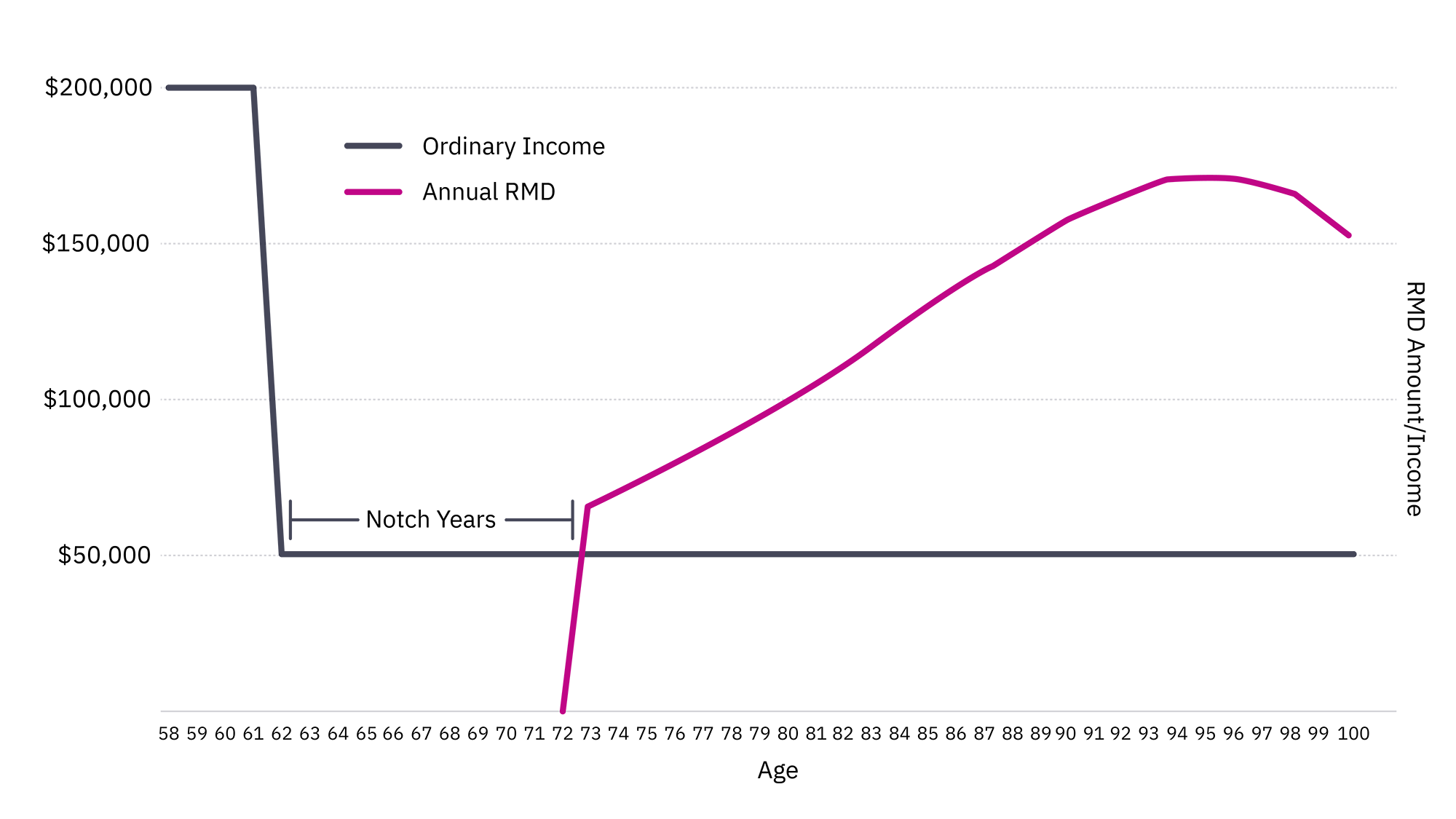
The notch years refer to the period between the date you retire and the age at which required minimum distributions (RMDs) begin. In 2026, it’s age 73, and for those born in 1960 or later, it’s age 75 according to the SECURE 2.0 Act. For many clients, this window represents a brief period of unusually low taxable income and potentially the lowest it will be for the rest of their lives.
When you retire, and your earned income stops, Social Security payments may not have begun or may represent a modest base. RMDs have not yet kicked in. And while your assets are intact, your taxable income for that window may be much lower than in your working years — and lower than it will be when distributions are mandatory.
Why this window matters
The income that will eventually come from your traditional IRA, 401(k), or other pretax accounts will be taxed as ordinary income at whatever rate applies at the time. This isn’t a choice; it is the mechanics of a pretax account. Every dollar in a traditional IRA is basically an IOU to the IRS.
Strategic Roth conversions during the low-income notch years between retirement and RMDs may reduce taxable income for both you and your heirs. Therefore, during the notch years, you may have the ability to convert pretax funds into a Roth IRA at tax rates that are lower than the rates you paid during your working years and potentially lower than the rates your heirs will pay when they inherit and distribute those funds.
The bracket argument
Many clients in their notch years are surprised to discover how much room exists in the lower tax brackets before they reach the 22% threshold (per 2026 tax rates). The space between your taxable income and the top of the 12% bracket may represent a lot of money per year in Roth conversion capacity at the lowest available rates.
Not taking advantage of using that capacity could result in a permanent missed opportunity. When you pass those years, you cannot go back and convert at previous rates.
The future tax rate argument
This analysis has a second layer. With historically large federal deficits and ongoing legislative discussion around tax policy, future rate increases represent a plausible scenario that an advisor should be modeling for you. Converting at today’s known rates, rather than deferring until rates are uncertain, may be the more defensible strategy.
Because of new tax law changes, more opportunities to take advantage of lower rate structures are available now than were available in the past.
A practical illustration
Consider a couple that retires in 2026 at age 65 with a pension of $50,000 per year. Social Security has not yet begun. RMDs have not yet kicked in. With the standard deduction, their taxable income is low enough to comfortably convert a meaningful amount each year at the 12% or 22% bracket. That’s well below what they paid during their working years. The conversion capacity disappears at age 73, when RMDs begin adding compulsory taxable income.
Running this projection is the kind of work that may not happen in a filing-only relationship. It usually requires a planning conversation, not a forms conversation, that involves modeling the conversion amounts, the tax cost today, and the projected RMD reduction and estate savings.
The Multigenerational Dimension
Tax planning for clients protecting established wealth doesn’t end with your own lifetime. The decisions you make today have direct implications for what your heirs receive and what they’ll owe at that time.
The inherited IRA problem
Under rules established by the SECURE Act and reinforced by its successor legislation, nonspouse beneficiaries who inherit a traditional IRA are generally required to fully distribute the account within 10 years of the original owner’s death. There are no minimum annual distribution requirements during most of those years, but the entire balance must be withdrawn by the end of the 10th year.
For clients with significant pretax balances, this means that the children who inherit those accounts may be forced to take large, fully taxable distributions during their own peak earning years. That’s exactly when they are least likely to want additional ordinary income and when the tax brackets they’re in may be at their highest.
With a large traditional IRA, every dollar will eventually be taxable, either for you or the person who inherits it.
How Roth conversions change the picture
Roth conversions done during the notch years address this problem on two levels:
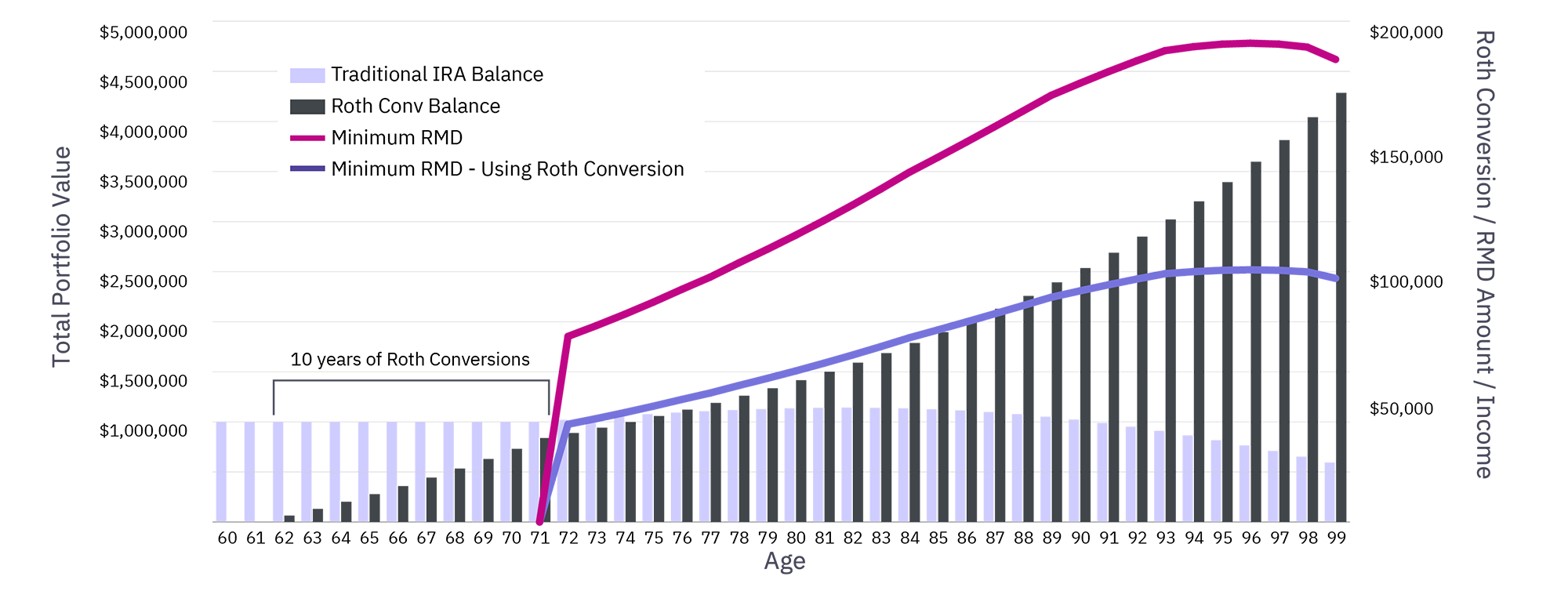
- Each dollar converted and taxed today reduces the pretax balance that ultimately drives RMDs, which reduces your own mandatory taxable income starting at age 73.
- Roth conversion reduces the inherited pretax balance your heirs will face, potentially replacing it with a Roth balance that grows and distributes tax-free.
The compounding effect of this kind of multigenerational planning may be substantial. Consider a couple with $600,000 in projected annual RMDs at age 73. Systematic Roth conversions during the notch years may significantly reduce that RMD base, lower the couple’s lifetime tax burden, and reduce what lands on their children as a taxable inherited distribution.
The conversation worth having
If your financial and tax planning has primarily focused on your own retirement income needs, it may be time to expand the conversation to include your heirs’ tax exposure. This isn’t estate planning in the traditional sense. It is tax-efficient wealth transfer, and it starts with decisions that you can make well before your estate documents are relevant.
Other Year-Round Tools Worth Knowing
Beyond Roth conversions and the structural planning described above, a comprehensive tax strategy may draw on a range of additional tools. Consider doing at least an annual review in the context of your specific situation.
Tax-loss harvesting
In a taxable brokerage account, positions that have declined in value may be sold to realize a capital loss, which can offset realized capital gains and up to $3,000 of ordinary income annually ($1,500 for married filing separately), with excess losses carried forward indefinitely. When done well and consistently, tax-loss harvesting may meaningfully reduce the tax drag on your portfolio over time. The most effective approaches can use technology to identify harvesting opportunities throughout the year, not just at year-end when opportunities may already be compressed.
Qualified charitable distributions (QCDs)
If you are age 70 ½ or older, you may direct up to $111,000 per year for 2026 (indexed for inflation) from your IRA directly to a qualified charity. A QCD transfers the IRA funds to charity without ever adding to your income. So you receive no charitable deduction, but you also pay no income tax on the distribution. At higher income levels, this is generally more tax-efficient than taking the IRA distribution as income and then deducting the charitable contribution. Critically, a QCD may also count toward your annual RMD, reducing your mandatory taxable income for the year.
Donor-advised funds
A donor-advised fund (DAF) allows you to contribute assets to a sponsoring organization in one year — receiving the full charitable deduction at the time of contribution — and then direct grants to qualified charities over time. When funded with appreciated securities rather than cash, you receive a deduction at fair market value and avoid capital gains on the appreciation entirely. Given the 0.5% AGI hurdle on itemized charitable deductions, coordinating DAF contributions with a high-income year (a business sale, a large Roth conversion year, or an appreciated asset sale) may produce a meaningfully better tax outcome than spreading smaller annual gifts across multiple returns.
Net unrealized appreciation (NUA)
If you hold employer stock inside a qualified retirement plan, such as a 401(k), a specialized distribution known as a lump-sum distribution may allow you to treat the appreciation on that stock as long-term capital gain rather than ordinary income. This net unrealized appreciation (NUA) strategy may produce lower tax rates on a portion of the distribution for eligible taxpayers. It requires careful structuring and should be evaluated in the context of your overall financial plan before any distribution is initiated.
Capital loss carryforwards
Realized capital losses that exceed the current year’s gains and the $3,000 ordinary income offset are carried forward to future years — indefinitely, with no expiration. These carryforwards can be an asset on your tax return, and they should be tracked, protected, and deliberately deployed. If your return shows a carryforward balance, make sure your investment decisions are taking it into account.
Income-related monthly adjustment amount (IRMAA) awareness
Medicare Part B and Part D premiums are based on your modified adjusted gross income from two years prior. Decisions made in 2026 — a large Roth conversion, a property sale, an IRA distribution — may increase your Medicare premiums in 2028. This is an opportunity to model any decisions with IRMAA thresholds in view and, in some cases, to spread the income over multiple years to potentially avoid or minimize premium surcharges.
Safe harbor estimated taxes
When you recognize significant income outside of wages — through Roth conversions, property sales, investment distributions, or business income — quarterly estimated tax payments become relevant and potentially urgent. The IRS safe harbor rules provide a threshold below which you generally avoid underpayment penalties. When planning any large income recognition event, make sure your quarterly payments are calibrated accordingly. A midyear income surprise can translate into an unexpected penalty if the payment schedule isn’t adjusted in time.
Starting Your Tax Plan
Tax planning isn’t a product or a form. It’s a discipline that requires looking at a full financial picture, not just last year’s return.
The strategies described in this guide — from Roth conversions to qualified charitable distributions to loss harvesting to SALT deduction analysis — all share one critical characteristic: They must happen before Dec. 31, not April 15 of the next year, to be effective. The filing deadline confirms what you’ve already done. The planning work is what helps determine whether what you’ve done was optimal.
If you are building on established wealth and thinking about retirement, legacy, and the tax efficiency of your overall financial picture, the difference between compliance and planning may be significant over a decade — and more when the multigenerational impact is included.
The most valuable work typically begins midyear, when the runway for the current year is still wide open and projections can still influence outcomes.
Learn more about tax planning and how it can integrate into your overall financial plan.

-
Tax preparation is the annual process of reporting past financial activity to comply with IRS filing requirements. It records decisions that have already been made and locks in your tax liability for the prior year. Tax planning is a forward-looking process — analyzing your current financial situation, projecting income, and implementing legal strategies throughout the year to reduce the taxes you’ll owe before the year ends. Preparation tells you what you owed. Planning influences what you may owe.
-
Proactive tax planning reduces taxes by structuring decisions before they’re locked in. Strategies such as timing income recognition, optimizing retirement account contributions, harvesting investment losses, converting pretax funds to Roth accounts at lower rates, and coordinating charitable giving may all produce lower taxable income. The key is that these moves have hard deadlines — most require action before Dec. 31 — so they require planning, not just filing.
-
The notch years refer to the period between when you retire and when required minimum distributions (RMDs) begin. During this window, many retirees experience unusually low taxable income. That gap may represent a significant opportunity to convert pretax retirement funds to Roth accounts at lower tax rates than you paid during your working years and at potentially lower rates than your heirs would pay on an inherited traditional IRA under the 10-year distribution rule.
-
When you convert traditional IRA funds to a Roth IRA, those assets grow and distribute tax-free. If your heirs inherit a Roth IRA, they may withdraw funds within the 10-year window without paying income tax on the distributions. By contrast, inherited traditional IRA funds are fully taxable as ordinary income when distributed. If your peak work years line up with the 10-year distribution window, the inherited tax burden may be substantial. Roth conversions done in your notch years may reduce that burden significantly
-
Roth conversions are most valuable precisely when you don’t need the money, because that typically means your income is lower and the conversion may occur at a favorable tax rate. For clients in their notch years — the time between retirement and RMDs — running the numbers with a wealth advisor may reveal meaningful conversion capacity that won’t exist following the start of RMDs. The question isn’t whether you need the money now — it’s whether paying tax today at known rates is preferable to paying tax later at uncertain rates.
-
A donor-advised fund (DAF) contribution may make sense in years when your income is unusually high — from a business sale, large Roth conversion, or other income event — because you receive the full charitable deduction in the year of contribution and may direct grants to charities over multiple years. When you fund a DAF with appreciated securities, you also avoid capital gains on the appreciation. Given the 0.5% AGI hurdle on itemized charitable deductions under the One Big Beautiful Bill Act of 2025, coordinating DAF contributions with high-income years may produce better outcomes than annual cash gifts.
-
Yes. If a Roth conversion generates significant taxable income outside of wages, you may owe quarterly estimated payments to avoid an IRS underpayment penalty. The safe harbor rules allow you to avoid penalties if your payments meet a certain threshold based on prior-year or current-year liability. Before initiating a large conversion, review your estimated payment schedule with a tax advisor to help ensure it’s calibrated correctly for the additional income.
-
Look for a fiduciary, fee-based registered investment advisor (RIA) that offers integrated tax and financial planning — not just portfolio management. Mercer Global Advisors offers comprehensive wealth management that coordinates tax, investment, and estate planning in a single relationship. If you’re a client and not using Mercer Advisors tax planning and preparation services, discuss them with your wealth advisor. If you’re not a client, a complimentary consultation with a Mercer Advisors wealth advisor may be a good first step in assessing whether your current approach is leaving planning value on the table.
-
The IRS website (irs.gov) provides official guidance on new legislation, though interpretation in the context of individual planning requires a personalized analysis. The Mercer Advisors wealth management team reviews legislative changes and their implications for our a client’s specific financial plan on an ongoing basis. For a summary of the changes discussed in this guide, consider scheduling a planning conversation with a Mercer Advisors wealth advisor.
-
These are complementary but different relationships. A CPA typically focuses on preparing and filing your return accurately — an essential function. A financial advisor who integrates tax planning looks at your broader financial picture year-round and makes forward-looking recommendations that help influence your tax outcomes before the year closes. For clients with complex financial pictures — significant investment assets, business interests, retirement accounts, or estate planning needs — a coordinated approach between a CPA or tax-planning professional and a financial advisor could produce significantly better outcomes than either relationship alone.
-
Both approaches are valid, and they aren’t mutually exclusive. Avoiding unnecessary capital gains by thoughtfully managing holding periods is always sound. Tax-loss harvesting adds value by systematically capturing losses in down positions, which may offset gains elsewhere in the portfolio and reduce current-year taxable income. Done well and consistently — rather than only at year-end when the best opportunities may already be gone — systematic loss harvesting may produce meaningful tax savings over time without fundamentally altering your investment strategy.
-
A qualified charitable distribution (QCD) is made directly from your IRA to a charity and never flows through your income — meaning you pay no income tax on that distribution, regardless of whether you itemize. A regular charitable deduction requires you to take the income (pay the tax), donate the cash, and then deduct it, subject to AGI limits and the requirement that you itemize. For clients over age 70 ½ with significant IRA balances, a QCD may be meaningfully more tax-efficient than a regular deduction, particularly at income levels where itemizing doesn’t provide a full benefit.
All expressions of opinion reflect the judgment of the author as of the date of publication and are subject to change. Some of the research and ratings shown in this presentation come from third parties that are not affiliated with Mercer Advisors. The information is believed to be accurate but is not guaranteed or warranted by Mercer Advisors. Content, research, tools and stock or option symbols are for educational and illustrative purposes only and do not imply a recommendation or solicitation to buy or sell a particular security or to engage in any particular investment strategy. Hypothetical examples are for illustrative purposes only. All investment strategies have the potential for profit or loss. Changes in investment strategies, contributions or withdrawals may materially alter the performance and results of your portfolio.
Tax preparation and filing services are provided by Mercer Advisors Tax Services, LLC. Clients will sign a separate agreement when engaging Mercer Advisors Tax Services that defines the services provided and any additional fees that may apply.