

Artificial intelligence (AI) is the most closely watched story in the market, and its influence reaches well beyond that of technology stocks. We see five major vectors through which AI is transforming financial markets and the broader economy. They don’t all point in the same direction, which is why the path of markets has been so hard to predict, and why investors benefit from understanding each one.
1. Interest rates: The cost of building AI
Building AI infrastructure requires capital on an enormous scale: data centers, specialized chips, and the power to run them. Much of this buildout is financed with debt, and as AI-related issuances approach $1 trillion, it is large enough to affect the U.S. Treasury market. With government borrowing already elevated, this new supply of debt is adding upward pressure on yields, particularly at the long end of the curve.
The chart below shows the scale of this investment and where projections suggest it is headed. Figure 1 shows AI-related debt capital expenditures are expected to surpass $1 trillion in 2027.
Implication for investors:
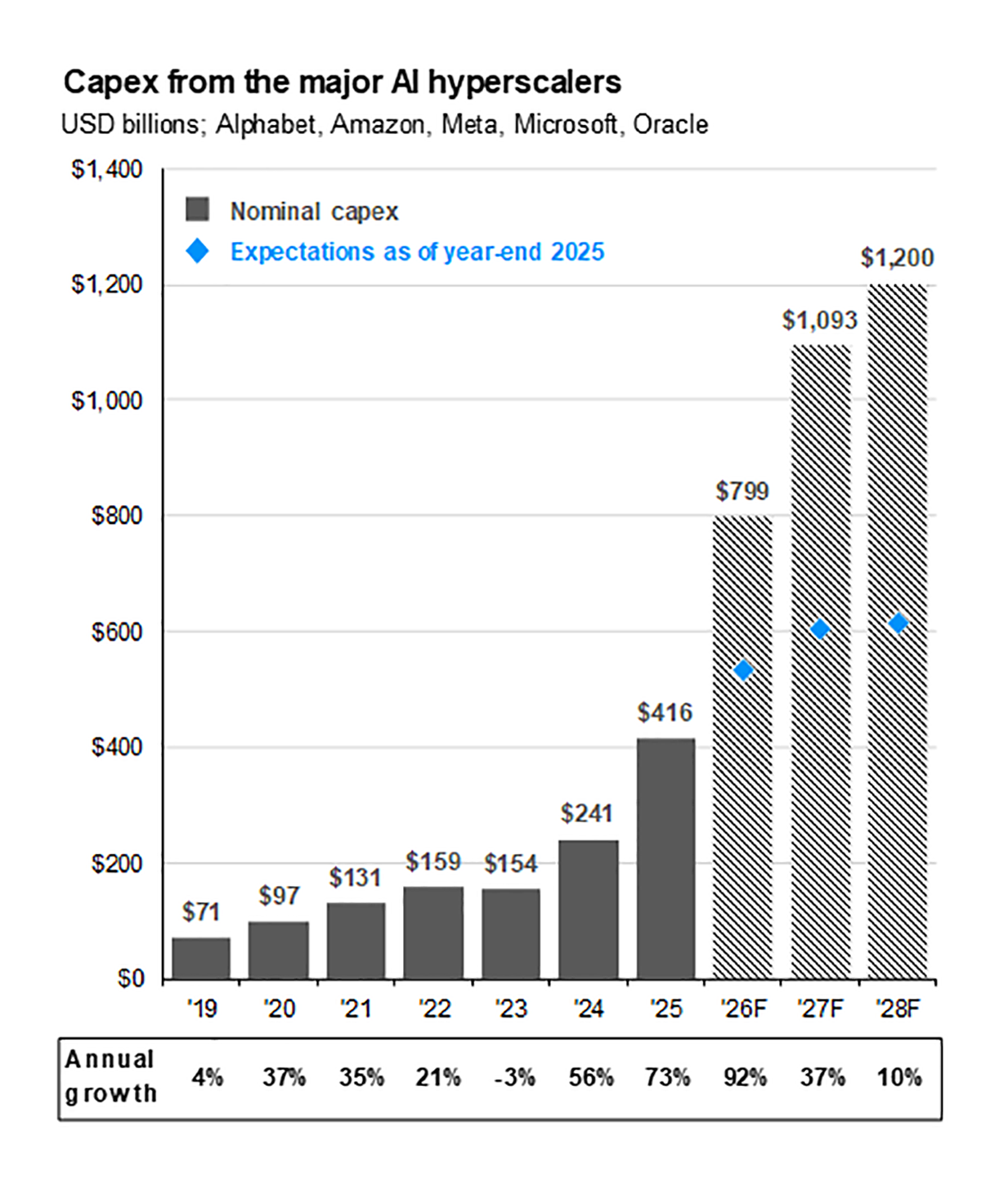
Source: Bloomberg L.P., JPMorgan Asset Management. Note: Data for 2026 –2028 reflect consensus estimates. Capex shown is company total. Guide to the Markets U.S. Data are as of Oct. 7, 2026.
2. Profits: Markets are betting on big payoffs
The bull case for AI is that it lifts productivity and margins across industries, well beyond the technology industry. Markets have taken that case to heart, and much of the expected gain is already reflected in stock prices. There is little reason to doubt that AI will boost productivity, but the open question is timing. If earnings growth arrives more slowly than prices assume, today’s valuations may prove too high.
That tension has already surfaced in the so-called Neocloud providers, companies that rent out AI processing power. Some investors have grown worried that certain firms in the sector may not generate enough revenue to cover the cost of their expansion, and their stocks have reflected it.
Implication for investors:
3. Labor: A slow-moving shift with long-term consequences
AI’s impact on the workforce is likely to unfold over years, not quarters. That timeline matters for investors. Labor market effects are gradual, uneven across industries, and difficult to model with any precision, which argues against making portfolio decisions based on any single forecast.
The potential consequences, however, are significant. If AI automates a meaningful share of knowledge work and shifts income from workers to capital owners on a large scale, the effects could ripple through the broader economy. Corporate margins could be supported, consumer purchasing power could soften, and political responses, from tax policy to labor regulation, could follow.
Implication for investors:



4. Concentration: A risk hiding in plain sight
A handful of technology companies now dominate the major market indexes to a historically unusual degree. The 10 largest companies in the S&P 500 (currently Nvidia, Apple, Microsoft, Alphabet, Amazon, Broadcom, Meta, Micron, Tesla, and AMD) account for 36% of earnings and more than 40% of market capitalization. As Figure 2 shows, there is no parallel for this level of concentration in recent history.
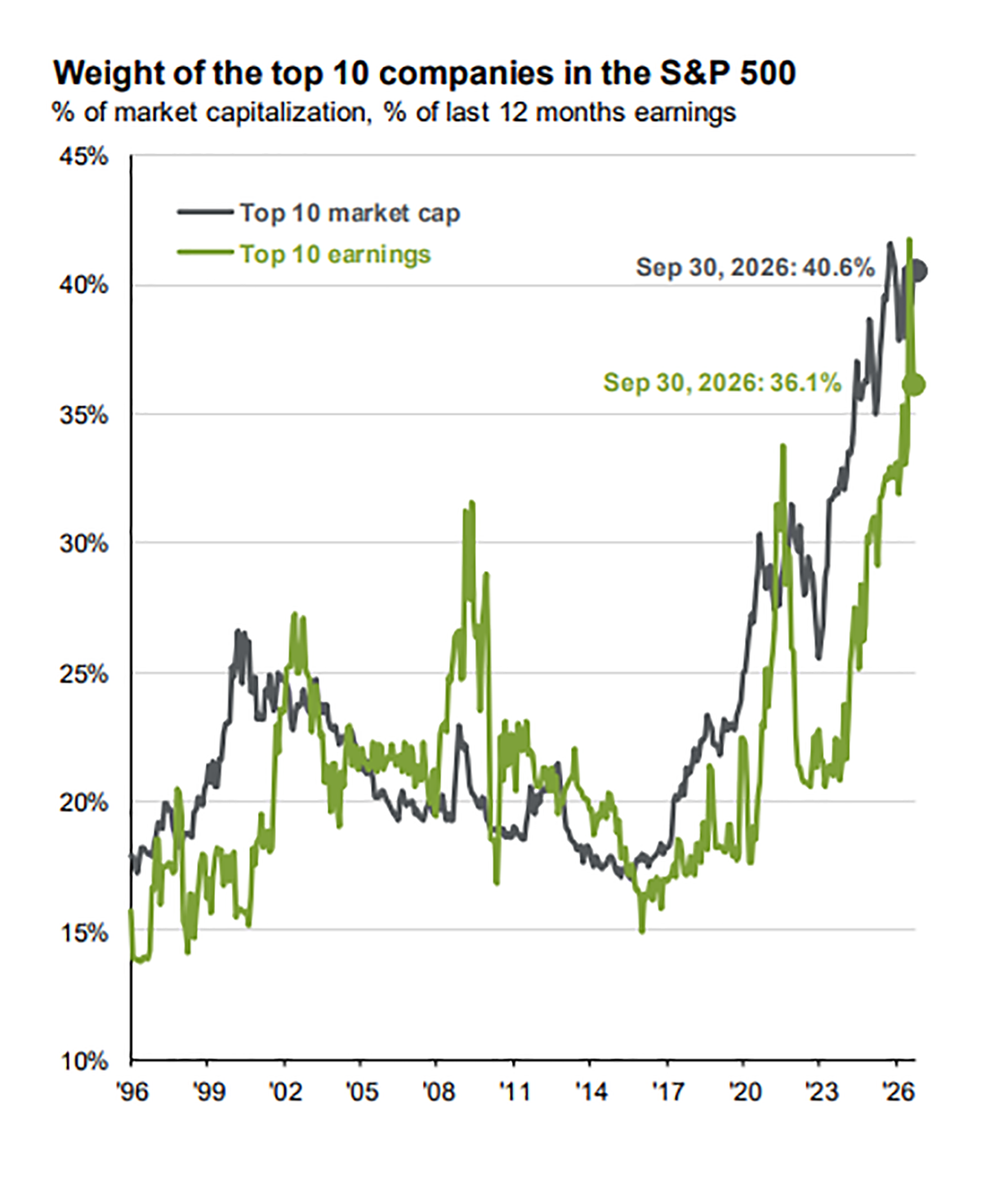
The practical consequence is that a broad index fund may carry a much larger bet on AI than its owner realizes, without any conscious decision to make it. Concentration amplifies outcomes: strong gains if AI delivers, and sharper drawdowns if it doesn’t.
Implication for investors:
5. Unseen risks: What the models don’t capture
Some of the most important risks are the hardest to quantify. Models perform best with measurable inputs like earnings, spending, and growth rates, but several of the risks that matter most today don’t show up in any of those. Four stand out:
- Capacity overbuilding. At some point, we may build more AI infrastructure, or more of certain types of infrastructure, than the near-term economy can absorb. Demand is measurable only after the fact.
- Circular financing. The major AI firms have invested in and provided financing to their own suppliers. That makes it difficult to measure how much of today’s demand is organic, or to know who might be “holding the bag” if the sector were to turn.
- Power and grid constraints. Beyond the effect on energy prices, the power grid has real physical limits, and capital spending at this scale could test them. Those limits are hard to quantify until they bind.
Public policy response. AI has become a subject of keen political interest, and additional policy is very likely in the coming years. But the market impact is not quantifiable in advance. Our refrain is that politics and investing don’t mix, and that holds here too: even if one could predict which lawmakers will write the next major round of AI regulation and which administration will implement it, it would still be impossible to predict the market outcome.
What this means for your portfolio
AI is a genuine force, in the economy and in markets. But genuine forces create winners and losers, and they bring volatility along the way. The five forces we’ve described do not move in unison: rising capital costs, rich valuations, a slow-moving labor shift, concentrated index exposure, and risks the models can’t measure all pull in different directions. That is why we believe the best response is discipline rather than prediction.
Three elements matter most.
- Diversification help protect against being wrong about which companies win.
- Duration awareness addresses the pressure AI-related borrowing is placing on long-term yields.
- A clear-eyed view of where AI risk sits in your holdings matters because many investors are carrying more of it than they realize, often through index funds they own for other reasons.
AI’s effects on markets and the economy will keep evolving, and we are monitoring the full landscape closely, from the pace of investment to the policy response. The best approach is to stay disciplined as the landscape shifts.
All expressions of opinion reflect the judgment of the author as of the date of publication and are subject to change. Some of the research and ratings shown in this presentation come from third parties that are not affiliated with Mercer Advisors. The information is believed to be accurate but is not guaranteed or warranted by Mercer Advisors. Content, research, tools and stock or option symbols are for educational and illustrative purposes only and do not imply a recommendation or solicitation to buy or sell a particular security or to engage in any particular investment strategy. All investing involves risk, including the possible loss of principal. All investment strategies have the potential for profit or loss. Diversification does not ensure a profit or guarantee against loss. Changes in investment strategies, contributions or withdrawals may materially alter the performance and results of your portfolio. Different types of investments involve varying degrees of risk, and there can be no assurance that any specific investment will either be suitable or profitable for a client’s investment portfolio. Indices are not available for direct investment. Economic factors, market conditions, and investment strategies will affect the performance of any portfolio and there are no assurances that it will match or outperform any particular benchmark. This document may contain forward-looking statements including statements regarding our intent, belief or current expectations with respect to market conditions. Readers are cautioned not to place undue reliance on these forward-looking statements. While due care has been used in the preparation of forecast information, actual results may vary in a materially positive or negative manner. Forecasts and hypothetical examples are subject to uncertainty and contingencies outside Mercer Advisors’ control.
For financial planning advice specific to your circumstances, talk to a qualified professional at Mercer Advisors.