

Treasury yields have climbed steadily this year, with longer-dated maturities drawing the most attention. The 30-year Treasury recently crossed 5.3%, its highest level since June 2007, prompting questions about what this means for investors’ portfolios.
This piece provides context on why yields have moved, the factors driving them higher, and how to make sense of fixed-income in this environment.
Bond yields in context
Yields are higher at all durations. The 10-year Treasury yield has risen from under 4% early in the year to 4.76% at the time of this writing. These are levels we’ve seen a few times in recent years.
The 30-year Treasury is a different story: At 5.3%+, it has reached its highest level in nearly two decades, which explains the media headlines and investor questions.
Figure 1: US Treasury Yield Curve
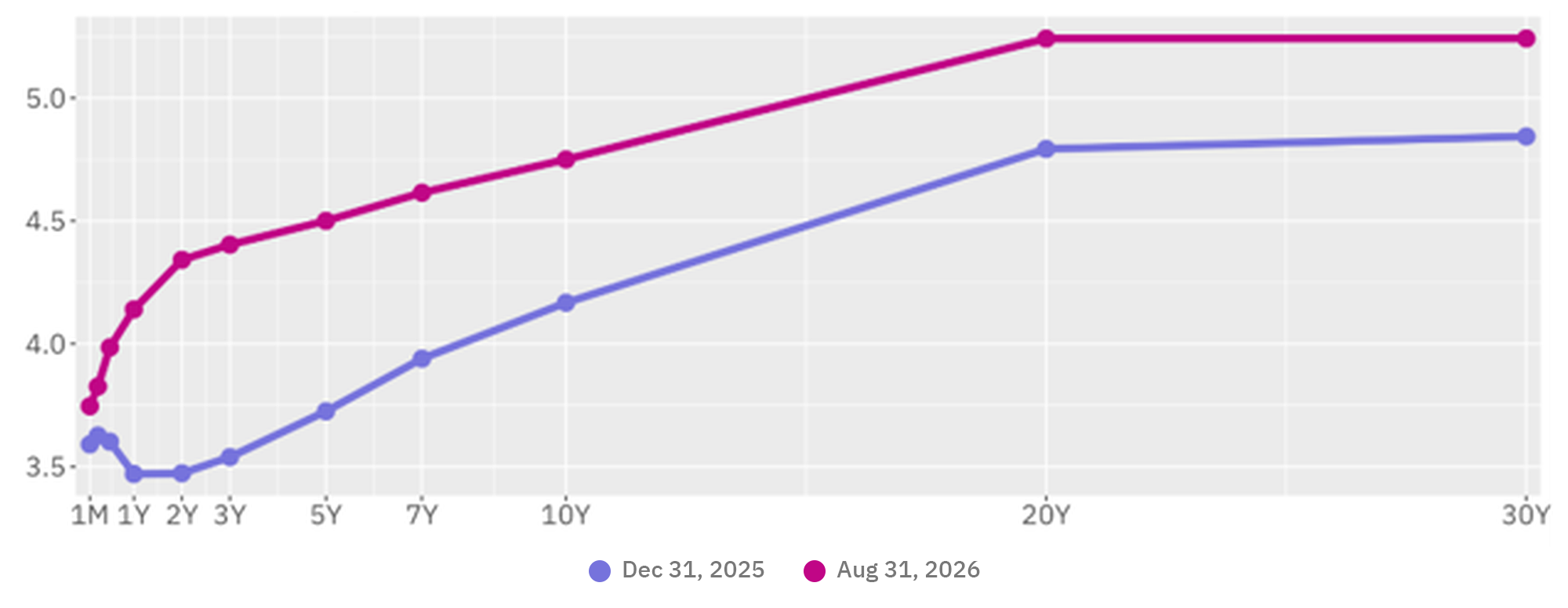
Source: Bloomberg Finance, LP, Mercer Advisors, as of 8/31/26.
Taking a long-run perspective, the U.S. bond market has been exiting an extended period of unusually low rates that began with the global financial crisis and ended with the pandemic, rather than entering a period of unusually high rates.
When yields rise, bond prices fall. The Bloomberg Aggregate Bond Index is down 0.5% year-to-date. By comparison in 2022, bond prices fell over 14%. A key difference between the impact on prices in 2026 versus 2022 is that starting yields were higher and there was income available to help mitigate the impact on overall returns.
While the movements this year have not been unduly alarming, we believe it is plausible that we are in the early stages of a secular shift toward an overall higher-rate environment — one that looks more like pre-2008 norms than the prolonged low-rate era that followed the global financial crisis.
Factors driving rates higher
Three primary factors are contributing to this higher rate environment.
1. Uncertainty around fiscal policy
A secular trend toward unsustainable deficit spending began somewhat before the global financial crisis, and reversing the tide has largely proved elusive to policy makers (of either party) for decades. At the beginning of this period, publicly held debt as a percent of gross domestic product (GDP) was low. As the debt has continued to rise, it is natural that investors may begin to demand a higher premium to lend money to the government.
Figure 2: U.S. Publicly Held Debt as a Percent of GDP
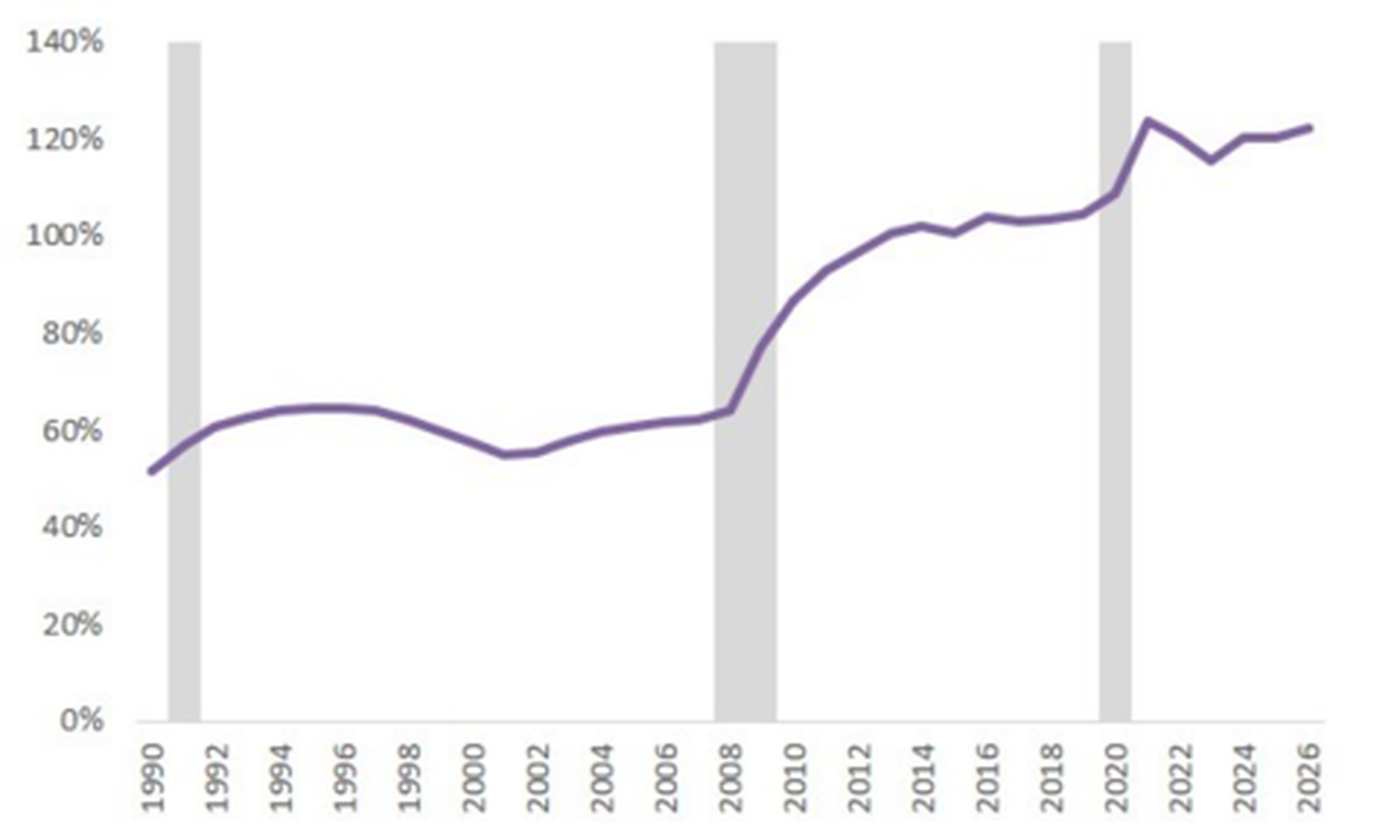
GDP: Gross Domestic Product. Gray bars represent recessions as identified by the National Bureau of Economic Research (NBER). Source: U.S. Treasury, NBER, Mercer Advisors, as of 6/30/26.
Compounding the problem, the cost of financing that debt (interest payments as a percentage of GDP) is rising sharply. The national debt grew during an era of very low bond yields, which masked the true burden of borrowing. When interest rates climbed in 2022 and 2023, the cost of servicing that debt surged.
Figure 3: Interest Outlays on the Federal Debt as a Percent of GDP
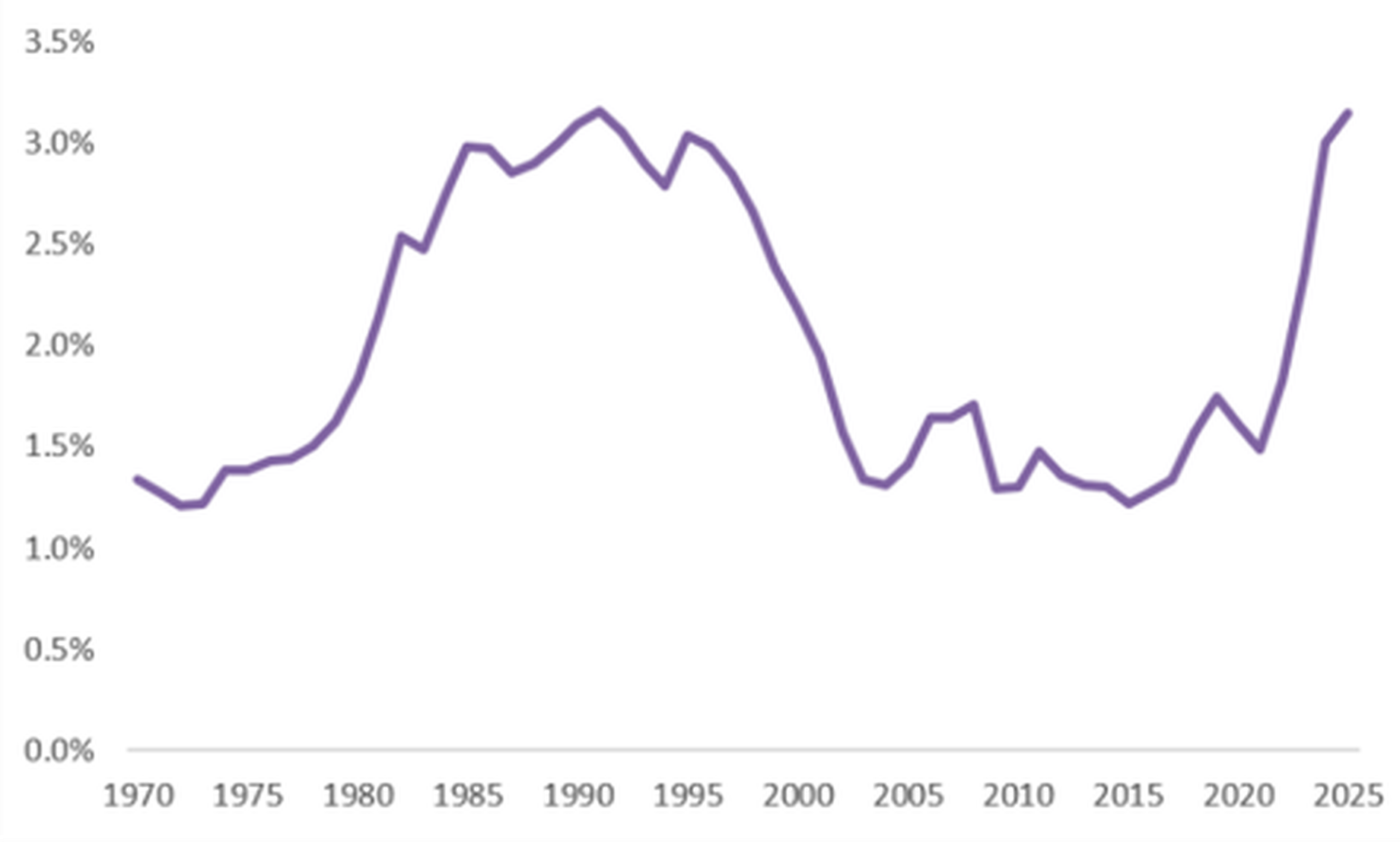
Source: Federal Reserve of St. Louis, U.S. Office of Management and Budget, Mercer Advisors, as of 12/31/25.
This creates a spiraling dynamic in which rising interest payments, on a rising volume of debt issuance, are themselves a fiscal burden which increases government expenditures.
There is no numerical threshold or trigger at which this mechanically becomes a crisis (Japan has muddled along with dramatically higher government debts of nearly 250% of GDP for over a decade) but the worsening trajectory introduces considerable uncertainty as to how U.S. policy makers will ultimately respond.
2. Uncertainty around inflation and monetary policy
The rising interest rates of recent years have coincided with a rise in inflation that has proven difficult for the Federal Reserve to control through monetary policy. While the Fed only directly controls short-term interest rates, long-term rates can reflect the market’s assessment that the Fed will be forced to maintain higher interest rates in the future to control persistent inflation.
The normal playbook to fight inflation is higher interest rates, which works by reducing demand throughout the economy through higher borrowing costs. But the current situation is largely a supply shock, where prices are being driven higher by disruptions in oil markets. The Fed has been raising rates anyway, and that is precisely what makes the situation complicated. Put simply: The Fed can tighten financial conditions, but it cannot boost oil production. That said, were inflation to subside, say from a resolution of the geopolitical conflict with Iran that have contributed to higher oil prices, the bond market may experience relief, and the Fed might not need higher interest rates.
In the absence of this relief, the fiscal policy environment makes monetary policy decisions even more difficult. Given the very high debt-to-GDP ratio, higher interest rates will exacerbate fiscal strains and make it harder to tame deficits. Higher deficits cause more inflation. This is not an easy carousel for policy makers to exit.
Additionally, the new Fed Chairman Kevin Warsh has adopted a strategy of saying less about his intentions for future interest rate changes. Warsh has argued that the Fed has sometimes communicated too much about its intentions for interest rates, to the point of binding their hands when circumstances change.
Time will tell if his change in strategy leads to a more flexible and effective Federal Reserve. In the meantime, his approach by design reduces certainty about the future path of interest rates. (See our previous communication: Why Interest Rate Outlooks Remain Unclear Under the New Fed Chairman)
3. A shift in who is buying U.S. Treasuries, and the boom in AI-related debt
Finally, the buyers and sellers (or borrowers and lenders) in global debt markets are undergoing some structural shifts which may have lasting impacts on U.S. interest rates.
First, a recent analysis from the Brookings Institution shows that foreign central banks are holding a smaller share of total U.S. debt than in the past, while U.S. private investors, particularly hedge funds, are holding more. While overall demand appears stable, with no shortage of participants at the Treasuries’ auctions, private investors may be more price-sensitive in their bond investments than foreign central banks.1
Second, the surge in debt related to the buildout of AI infrastructure and hyperscalers has become so significant that it may be contributing to the increase in yields. A recent JPMorgan Chase & Co. analysis shows AI-exposed companies have risen to represent about 16% of the investment-grade corporate bond market, larger than the financial sector.2
The sheer volume of AI-related issuance may now be large enough to draw capital away from Treasuries at auction, competing for the same pool of fixed-income investors.



Our takeaways
- The movement in bond yields this year is not surprising nor dramatic, given an uncertain outlook for fiscal policy, inflation, and the Fed. The repricing of bond markets so far this year is within the bounds of how we’d expect the asset class to behave in the long term. Though yields are high, they are not unusually high from a long-term perspective. A range of factors is putting pressure toward higher yields, and while the case for this pressure continuing is strong, it is not inevitable.
- As long-term investors, bonds continue to provide diversification and rebalancing benefits. We invest continuously, not one time. Bonds are down slightly this year, which means that when we rebalance our portfolios, we will be purchasing cheaper bonds which come with a higher yield. Each client’s risk tolerance, time horizon, and investment goals shaped their original portfolio mix, and those fundamentals have not changed. There is no reason to abandon the plan, as we have always expected there would be bumps along the way.
- We will continue to closely monitor the changing environment for bonds. Though we are not unduly alarmed about the current environment for bonds, we are always mindful of how quickly the world can change and will continue monitoring these trends to guide our approach to fixed-income investing.
If you are a Mercer Advisors client and have questions regarding the information provided above, please reach out to your advisor.

1 “The United States and Its Creditors: Assessing Foreign Demand for U.S. Assets,” Brookings Institution, August 2026.
2 “The J.P. Morgan View: Crowding Out, Steeper Curve: Carry Through Jackson Hole,” JPMorgan, Aug. 22, 2026.
All expressions of opinion reflect the judgment of the author as of the date of publication and are subject to change. Some of the research and ratings shown in this presentation come from third parties that are not affiliated with Mercer Advisors. The information is believed to be accurate but is not guaranteed or warranted by Mercer Advisors. Content, research, tools and stock or option symbols are for educational and illustrative purposes only and do not imply a recommendation or solicitation to buy or sell a particular security or to engage in any particular investment strategy. All investing involves risk, including the possible loss of principal. Past performance may not be indicative of future results
These links are being provided as a convenience and for informational purposes only; they do not constitute an endorsement or an approval by Mercer Advisors of any of the products, services or opinions of the corporations or organizations or individuals represented in the links. Mercer Advisors bears no responsibility for the accuracy, legality or content of the external sites or for that of subsequent links. Contact the external site for answers to questions regarding its content.
Diversification does not ensure a profit or protect against a loss. Different types of investments involve varying degrees of risk, and there can be no assurance that any specific investment will either be suitable or profitable for a client’s investment portfolio. Economic factors, market conditions, and investment strategies will affect the performance of any portfolio and there are no assurances that it will match or outperform any particular benchmark.
For financial planning advice specific to your circumstances, talk to a qualified professional at Mercer Advisors.