

So far this year I’ve had the opportunity to meet with thousands of clients across the country. I traveled from California to New York and many, many places in between. Everywhere I went, clients asked the same thing.
No, not about AI, the Iran war, or the midterms (although those were certainly popular topics). They asked about bonds and whether investors should continue to own them in their portfolios.
A quick primer on bonds
Rising yields have led many investors to ask what role bonds should play in their portfolios. Understanding the roles of bonds is key to understanding how and why investors should continue to hold bonds.
A bond is simply a loan from an investor to a national government, a government-related entity such as an agency or school district, or a corporation. The borrower typically pays periodic interest and returns principal at maturity, provided it does not default. Because bondholders are creditors, their claims rank ahead of those of stockholders, which generally reduces their risk relative to equities.
The three roles of bonds
Within a diversified portfolio, bonds can perform three distinct roles:
- Income generation. Bonds provide a contractual stream of interest, but yield is compensation for risk. Higher yields often reflect a highly levered issuer (one carrying substantial debt relative to equity) or a bond that is junior to other debt in the issuer’s capital structure.
- Capital preservation. Bonds with less credit (default) risk or interest-rate risk generally offer better principal preservation during periods of market stress. Shorter-duration bonds are less sensitive to changes in rates, as discussed below, and high-quality issuers tend to be more liquid and less sensitive to shocks such as recessions.
- Equity diversification. Some bonds move less in tandem with stocks and provide ballast when equity markets decline. These are typically shorter-duration obligations of governments or of firms with exceptionally strong balance sheets.
The roles conflict: High-income bonds usually carry greater default risk and behave more like stocks, which limits their diversification value, so investors must choose which roles to emphasize (Exhibit 1).
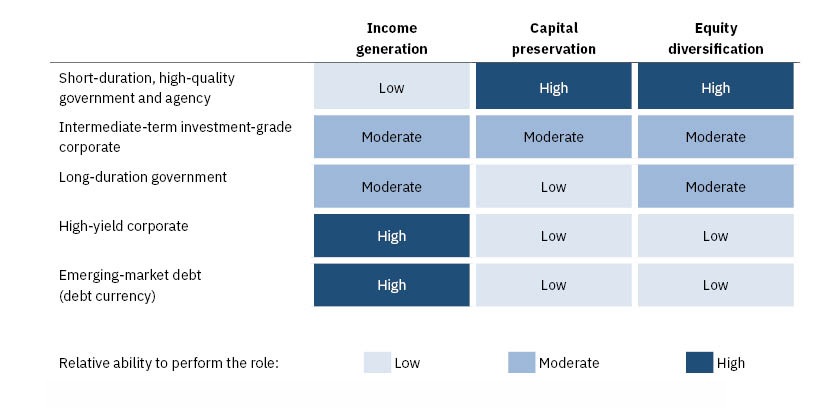
Note: Illustrative, qualitative tendencies; relationships can change across market environments. Capital preservation reflects credit and interest-rate risk.
Bond duration and interest-rate sensitivity
A bond’s price is the present value of its future cash flow — its coupon payments and the return of principal — discounted at the prevailing market yield. When yields rise, those cash flows are discounted at a higher rate and the price falls. The effect compounds with time: A payment due in 20 years is discounted over many more periods than a payment due in two, so the same change in yield erodes the present value of the longer-duration bond far more. A long-term bond has more of its value concentrated in distant payments, while a short-term bond returns most of its value soon, leaving less of it exposed to a change in rates. Duration, roughly the weighted-average time until a bond’s cash flows are received, summarizes this exposure. As a rule of thumb, a bond’s price moves by about its duration, in percent, for each one percentage point change in yield, in the opposite direction.
Exhibit 2 illustrates the effect for par bonds with a 4.84% coupon, close to the 10-year Treasury yield at the Nov. 5 close. A 0.67 percentage point rise in yields, this year’s increase in the 10-year yield, would lower the price of a two-year bond by about 1.3%, a five-year bond by about 2.9%, a 10-year bond by about 5.1%, and a 30-year bond by about 9.8%.
Shorter-term bonds have a second advantage: They mature sooner, so principal can be reinvested at the higher yields now available. The trade-off is that shorter-term bonds usually pay less yield for similar credit quality, a cost that is consistent with emphasizing capital preservation over income maximization.
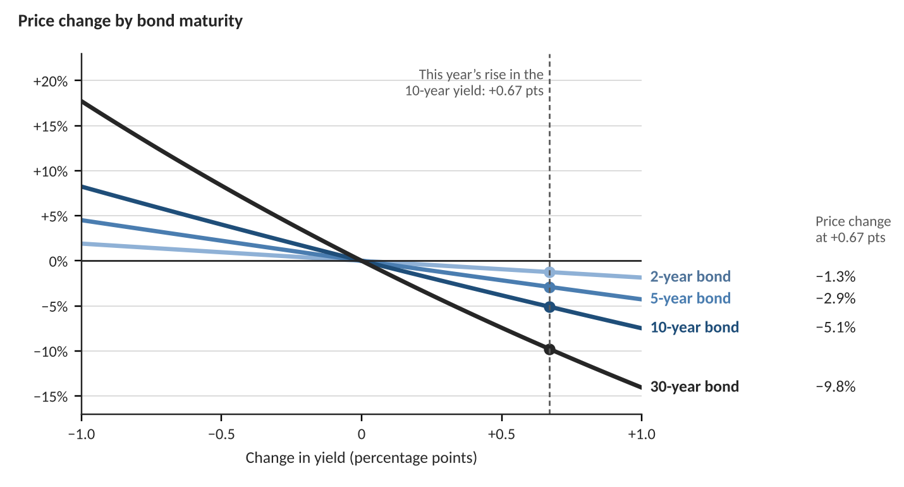
Note: Illustrative par bonds with a 4.84% semiannual coupon, priced with standard present-value formulas. Price changes exclude income earned over the period, which offsets part of any price decline.
Seniority in the capital structure
A company’s capital structure is the mix of claims that finance its assets: secured and unsecured debt, preferred stock, and common stock. If the company becomes distressed, claims are generally paid in order of priority, with each class paid in full before the next receives anything (the absolute priority rule, although negotiated Chapter 11 outcomes sometimes depart from it).
Seniority is relative: A claim is senior to those below it and junior to those above it (Exhibit 3). A high-yield bond, for example, is senior to stockholders but may be junior to the firm’s secured loans and earlier senior bonds. The lower a claim sits, the lower its expected recovery, and therefore the higher the yield it demands and the more its price tends to follow the issuer’s equity. Junior claims can enhance income at the expense of capital preservation and diversification.
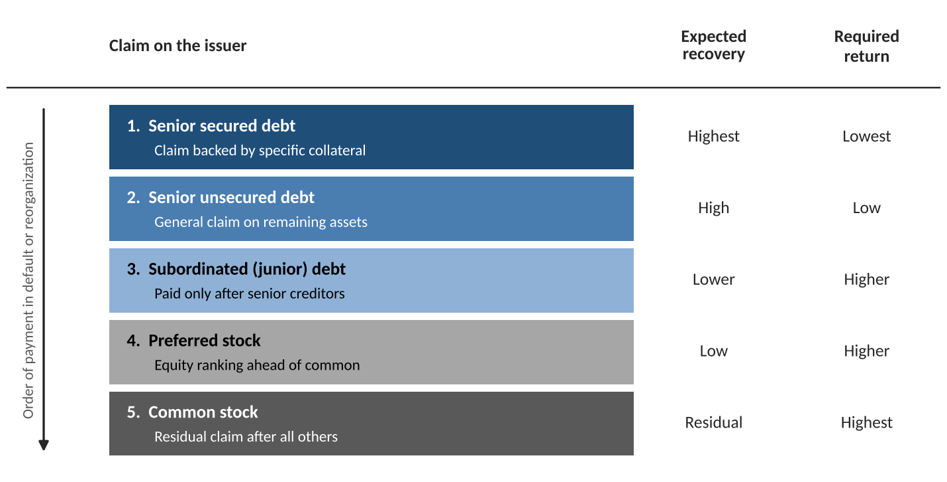
Note: Rows 1 through 3 are creditor claims; rows 4 and 5 are ownership claims. Recovery and required return are relative, qualitative characterizations.
How Mercer Advisors positions bonds
Most families need heavy allocations to public and private equity, which behave similarly because they share exposure to gross domestic product growth and interest-rate risk. Public equity can be highly volatile, and private equity is notoriously illiquid, so bonds are positioned to complement equities rather than replicate their risk. How the trade-off among the three roles is resolved depends on which Mercer Advisors portfolio series an investor is using.



| Portfolio series | Primary role of bonds | Trade-off accepted |
|---|---|---|
| Market and Multifactor Series | Preserve capital and diversify riskier equity investments | Forgone income maximization |
| Income Series | Prioritize higher income | Potentially less capital preservation and diversification when equity markets decline |
Four characteristics. Relative to the global marketplace, bond allocations emphasize a U.S. overweight (preserving capital in dollars), hedged currency exposure (keeping the focus on bond performance rather than currency swings), shorter duration (less sensitivity to interest-rate changes), and higher quality (limiting high-yield and emerging-market debt, which move with stocks more frequently).
Year-to-date performance and its drivers
As of Nov. 5, the Bloomberg U.S. Aggregate Bond Index was down 0.06% year to date, and the Bloomberg Global Aggregate Bond Index, unhedged to the U.S. dollar, was down 0.71%. The USD-hedged Global Aggregate was up 0.81%. This gap of roughly 1.5 percentage points illustrates how much currency exposure contributed to results this year (Exhibit 4).
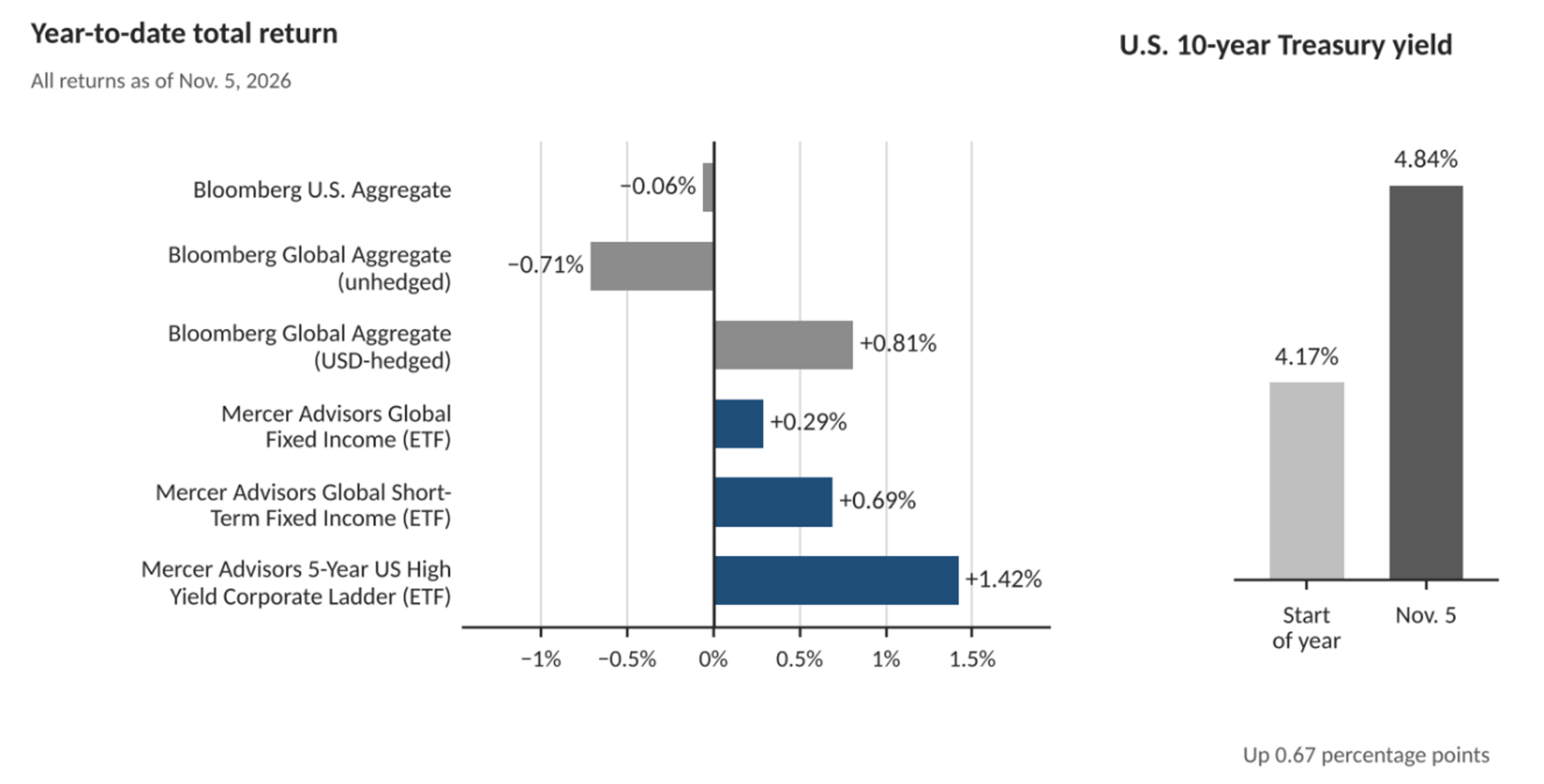
Sources: Bloomberg; Mercer Advisors; market data. All returns are as of Nov. 5, 2026; the Treasury yield is approximate. Index returns are unmanaged and cannot be invested in directly. Past performance does not guarantee future results.
So, why are bond markets negative so far this year?
Rising interest rates
The principal driver is higher rates. The 10-year Treasury yield stood at about 4.84% at the Nov. 5 close, up 0.67 percentage points from 4.17% at the start of the year. When rates rise, the interest payments on existing bonds become less attractive relative to new issues, and prices fall. By the duration rule of thumb, a portfolio with a six-year duration would lose roughly 4.0% from a parallel 0.67 percentage point rise in yields; this is for illustration only, since yield curves seldom move in parallel and income earned offsets part of the decline. Contributing factors include rising inflation, Federal Reserve policy tightening and uncertainty, large government deficits, and heavy debt issuance by large technology companies.
Offsetting forces
A positive growth backdrop for high-quality corporate borrowers and strong demand for their debt have narrowed credit spreads, the extra yield a corporate bond pays over a Treasury of the same maturity. That demand has cushioned the effect of higher government yields.
Key takeaways
- Investors should continue to own bonds. If bonds were good enough to own at the start of the year when yields were 4.17%, they’re may be even more attractive now with yields at 4.84%. And at today’s equity market valuations, allocating to diversifiers is critical to building a fortress balance sheet capable of weathering the next bear market. (I’m not predicting one; I’m just acknowledging that one will show up again at some point.)
- Shorter duration, higher quality, and hedged currency exposure have helped this year. Bonds with those characteristics were still affected by market uncertainty but generally performed better than unhedged, longer-duration alternatives. The takeaway is that our approach to portfolio construction works.
- The 60/40 portfolio is not dead. I wish I had a nickel for every time I’ve heard this claim. Rather than relitigate this here, I’ll just say that if 60% equity/40% fixed income portfolios were previously “dead” because of near-zero rates, then it logically follows that today’s higher rates have helped restore the diversification power of bonds relative to equities. That’s great news for our clients and great news for advisors like us working hard to shepherd our clients to Economic FreedomTM. Higher rates make our job relatively easier, and a high-quality, thoughtful approach to how we think about bonds and portfolio implementation makes our job easier still.

All expressions of opinion reflect the judgment of the author as of the date of publication and are subject to change. Some of the research and ratings shown in this presentation come from third parties that are not affiliated with Mercer Advisors. The information is believed to be accurate but is not guaranteed or warranted by Mercer Advisors. Content, research, tools and stock or option symbols are for educational and illustrative purposes only and do not imply a recommendation or solicitation to buy or sell a particular security or to engage in any particular investment strategy. Different types of investments involve varying degrees of risk, investments mentioned in this document may not be suitable for all investors. Investments are subject to market risk, including the possible loss of principal. Past performance may not be indicative of future results. Future investment performance cannot be guaranteed. All investment strategies have the potential for profit or loss. Changes in investment strategies, contributions or withdrawals may materially alter the performance and results of your portfolio. Portfolio management strategies such as diversification, asset allocation, and rebalancing do not ensure a profit or guarantee against loss. Indices are unmanaged and index returns do not include fees or expenses typically incurred in the management of an investment portfolio. Indices are not available for direct investment.
This content may contain forward looking statements including statements regarding our intent, belief or current expectations with respect to market conditions. Readers are cautioned not to place undue reliance on these forward-looking statements. While due care has been used in the preparation of forecast information, actual results may vary in a materially positive or negative manner. Forecasts and hypothetical examples are subject to uncertainty and contingencies outside Mercer Advisors’ control.
For financial planning advice specific to your circumstances, talk to a qualified professional at Mercer Advisors.