
The recent reacceleration of the Iran war is renewing concerns about its impact on global energy markets and potential spillover into the broader economy. Now six months into the conflict, commercial and strategic oil reserves are nearing historic lows, and a recent spate of attacks by Iran and its regional proxies threaten to broaden the conflict and expand supply disruptions. In this communication, we highlight four key trends in global energy markets and offer takeaways for investors.
The upshot:
- Global energy supply is falling short of demand, pushing U.S. energy prices up 16% year-over-year, according to the Consumer Price Index.1 According to International Energy Agency estimates, global oil consumption is expected to exceed production by an estimated 3.9 million barrels per day this year, a likely indicator of further price pressure. Relief is possible in 2027 if the conflict resolves, but the near-term outlook points to prices remaining elevated.
- American consumers are feeling it at the pump. The average price of a gallon of gasoline has topped $4.48, up 40% from a year ago. So far, consumer spending remains resilient, with households saving less rather than cutting back consumption.
- The U.S. is better insulated than most economies from direct impacts. The U.S. imports less than 10% of its energy from the Persian Gulf and stands as a net energy exporter.
- We continue to monitor inflation and interest rates. Medium- and long-term inflation expectations remain anchored, and higher energy prices have so far had a limited impact on core inflation (headline inflation minus food and energy). While Middle East uncertainty may be contributing to rising bond yields, a broader range of factors, including growth, U.S. fiscal deficits, and Fed policy uncertainty, are likely driving higher long-term rates.
- Portfolio diversification and duration management matter. Maintaining diversified portfolios remains the right course. In fixed income, we’re mindful of duration risk — most of our portfolio durations are positioned somewhat shorter than the broad benchmark, which helps reduce sensitivity to rate movements during a period of heightened uncertainty.
Global supply and demand point to higher prices in the near term
As the war in the Middle East persists, energy prices (gasoline, fuel oil, electricity, and natural gas) unsurprisingly remain elevated. Figure 1 compares the global supply (production) and demand (consumption) for global energy. Based on estimates from the International Energy Agency, global consumption is expected to exceed production by 3.9 million barrels per day in 2026, driving further price pressure. The outlook for 2027 remains highly uncertain and is dependent on resolution in the Middle East. If the conflict resolves, supply is expected to exceed demand next year because of a combination of pent-up supply and some demand destruction from elevated prices.
Figure 1. Global demand for liquid fuels is expected to significantly outstrip supply in 2026
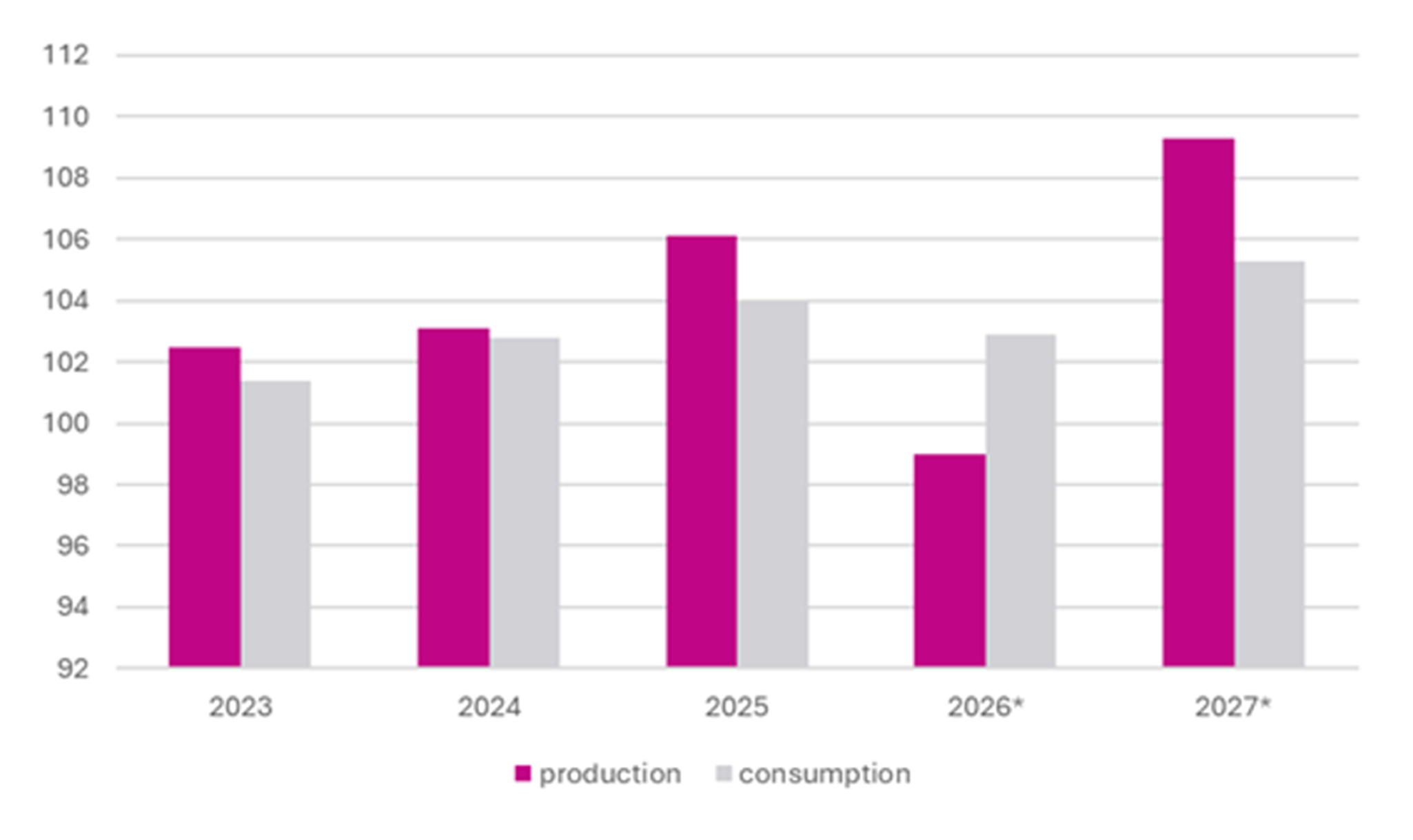
Barrels per day (millions)
Source: FactSet, J.P. Morgan Asset Management; (Top and bottom left) EIA. Forecasts are from the April 2026 EIA Short-Term Energy Outlook and start in 2025. Liquid fuels include crude oil, natural gas, biodiesel, and fuel ethanol. WTI crude prices are based on NYMEX continuous-contract futures prices in U.S. dollars. Guide to the Markets — U.S. Data are as of Sept. 11, 2026.
U.S. prices are still reacting to the disruptions
The largest share of household energy expenditure is typically at the gas pump. U.S. consumers face an average price of $4.48 per gallon of gas, about 40% higher than a year ago. Meanwhile, diesel hit a record $6.51 as of this writing. Current retail gasoline futures indicate that markets expect gasoline prices to remain elevated well into the first quarter of 2027 and above prewar levels for the foreseeable future (shown in Figure 2 as the difference between the raspberry and purple dots).
Despite these pressures, consumer spending, which accounts for over two-thirds of the economy, remains robust. Rather than cutting back, households appear to be absorbing higher energy costs by saving at a lower rate. That resilience is an important signal: Higher energy prices are a headwind, but they have not yet translated into a pullback in economic activity.2
Figure 2. Retail gasoline price outlook today vs. prewar
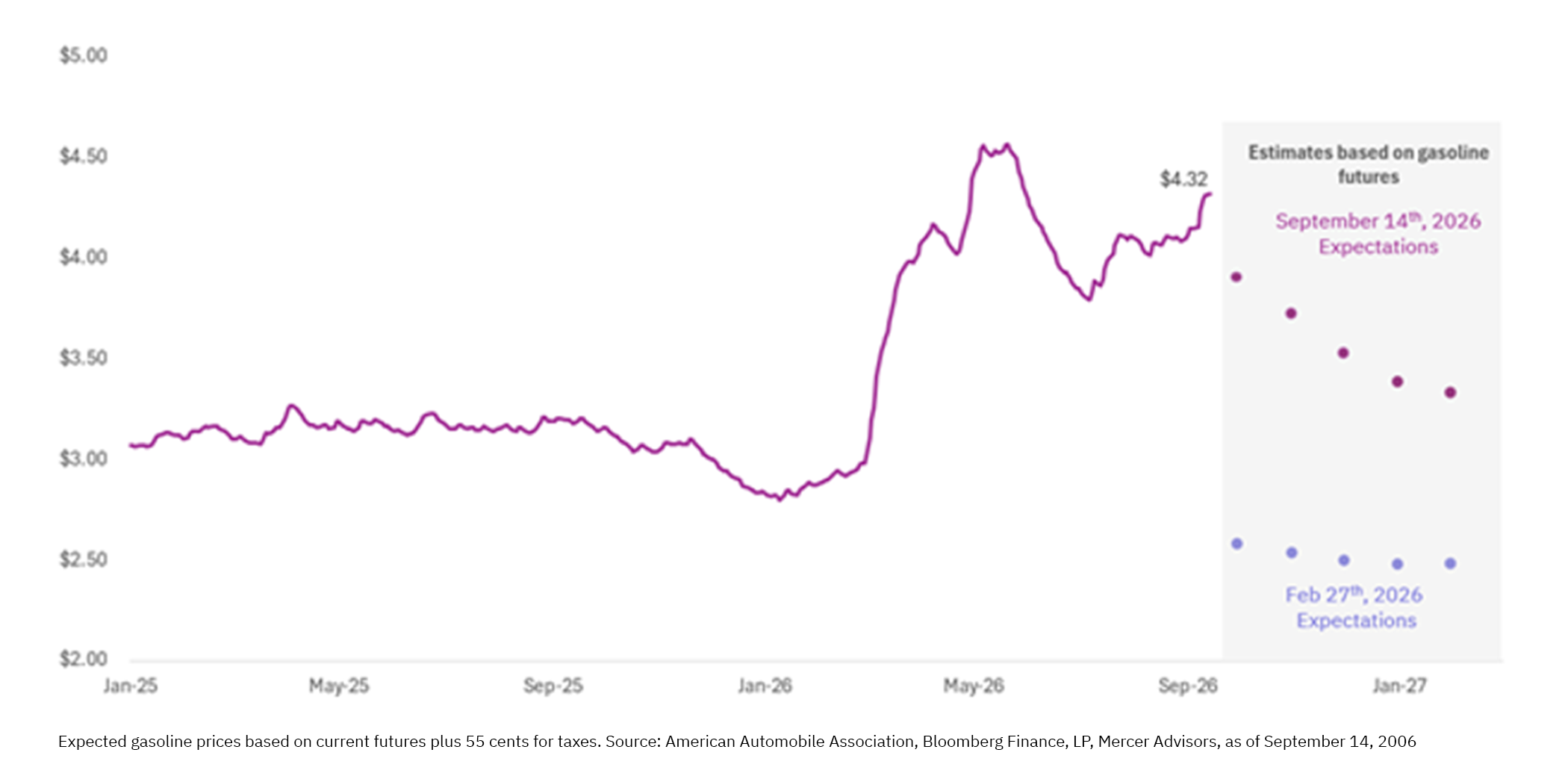
Retail gasoline prices and outlook as of Sept. 14, 2026
Note: Expected gasoline prices based on current futures plus 55 cents for taxes.
Source: American Automobile Association, Bloomberg Finance, LP, Mercer Advisors as of Sept. 14, 2026.
The U.S. economy is less exposed relative to other economies
Despite increased energy costs, the U.S. economy is far less exposed to the direct impacts of Middle East supply disruptions than most other major economies. As shown in the data in Figure 3, the U.S. imports less than 10% of its energy from the Persian Gulf and is a net energy exporter overall — a position that provides some insulation from the current disruptions. Asian economies face considerably more exposure: China, South Korea, Japan, and India each source 40%-60% of their energy from the Persian Gulf region, per the below data from J.P. Morgan.
China has so far cushioned the global impact by drawing on its substantial strategic energy reserves. However, according to the Wall Street Journal article on dwindling stockpiles, it has recently resumed larger purchases from international suppliers, a shift that adds to global price pressures.
Figure 3. Energy imports from the Persian Gulf
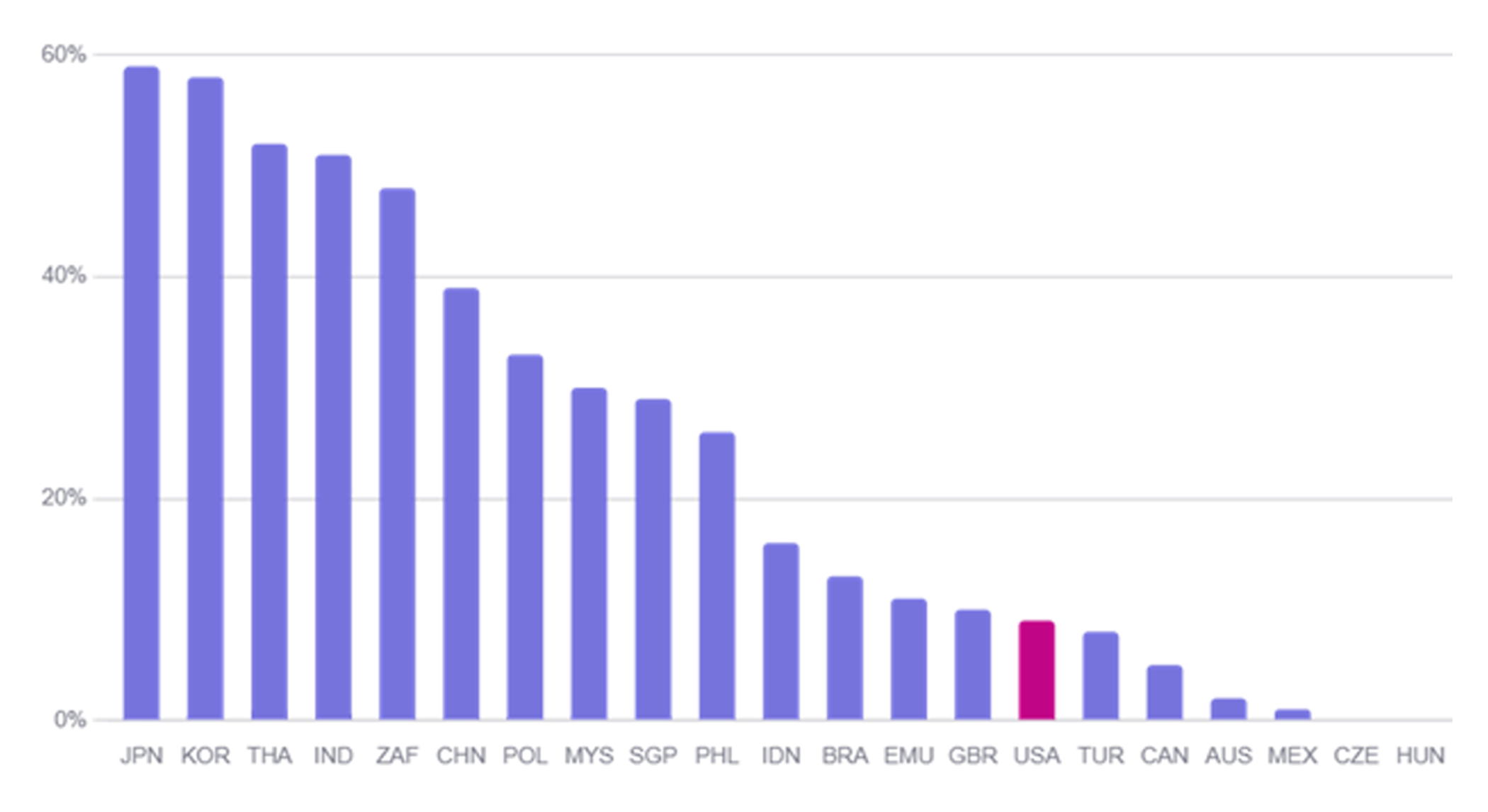
Share of total domestic imports of crude, refined, and LNG
Source: US Comtrade, J.P. Morgan Guide to the Markets. HS codes 2709-2711; Mercer Advisors
Higher energy prices and the inflation outlook
How are higher energy prices impacting the broader economy? Two main concerns arise with a sustained oil shock. The first is that higher energy costs begin to flow through to the prices of other goods and services since energy is a key input across much of the economy. So far, we see limited evidence that higher gas prices are leading to elevated core inflation, a measure that excludes the more volatile categories of food and energy.
The second concern is the potential for higher energy prices to unsettle inflation expectations. Here too, the news is relatively reassuring at the moment. The U.S. economy is considerably less energy-intensive than in past decades, and inflation expectations appear to remain well-anchored.
Long-term interest rates have climbed during the Iran conflict, and some observers may naturally assume a connection. Heightened geopolitical uncertainty can push up the term premium — the extra yield investors demand for holding longer-duration bonds when the future feels less predictable. But the Iran war is likely a modest contributor. The more powerful forces driving long-term yields higher are likely closer to home: stronger-than-expected economic growth, persistent inflation uncertainty, record federal debt and deficits, and the surge in AI-related capital expenditure.
1 “Consumer Price Index Summary – August 2026.” Bureau of Labor Statistics (Sep. 11, 2026).
2 According to data from the Bureau of Economic Analysis, the saving rate has fallen from 4.5% a year ago to 3% as of July. “Personal Saving Rate.” U.S. Bureau of Economic Analysis (Aug. 26, 2026).
All expressions of opinion reflect the judgment of the author as of the date of publication and are subject to change. Some of the research and ratings shown in this presentation come from third parties that are not affiliated with Mercer Advisors.
The information is believed to be accurate, but is not guaranteed or warranted by Mercer Advisors. This information is not intended as a recommendation or solicitation to buy, sell, or hold, any particular security or to engage in any particular investment strategy. Different types of investments involve varying degrees of risk, investments mentioned in this document may not be suitable for all investors. Investments are subject to market risk, including the possible loss of principal. Past performance may not be indicative of future results. Future investment performance cannot be guaranteed. All investment strategies have the potential for profit or loss. Changes in investment strategies, contributions or withdrawals may materially alter the performance and results of your portfolio. Portfolio management strategies such as diversification, asset allocation, and rebalancing do not ensure a profit or guarantee against loss. Indices are unmanaged and index returns do not include fees or expenses typically incurred in the management of an investment portfolio. Indices are not available for direct investment.
This content may contain forward looking statements including statements regarding our intent, belief or current expectations with respect to market conditions. Readers are cautioned not to place undue reliance on these forward-looking statements. While due care has been used in the preparation of forecast information, actual results may vary in a materially positive or negative manner. Forecasts and hypothetical examples are subject to uncertainty and contingencies outside Mercer Advisors’ control.