

Former President Donald Trump’s return to Washington after four years has been the focus this past week and there’s now been enough time to reflect and provide some takeaways from the market’s reaction. At the time of writing, the S&P 500 has climbed almost 4% since its close on Tuesday, before the election results were tabulated. The yield on the 10-year Treasury initially climbed from 4.28% to about 4.5% before drifting down later in the week.
This initial reaction – dubbed the “Trump trade” in financial markets – provides some insight into what the Trump administration might mean for markets and the broader economy.
Our intention here isn’t to praise or denigrate either candidate or their respective economic policies; our goal is simply to provide post-election commentary on their likely economic impact. A recurring theme of our commentary around the election has been that politics and investing don’t mix. In other words, neither excitement nor disappointment about an election outcome should prompt one to overhaul their investing strategy. We still believe this to be the best course of action for long-term investors.
Lessons from Equity Markets
Many have been quick to attribute the climb in the stock market to the prospect of business-friendly policies, less regulation, and lower taxes. Indeed, over the long-term we would expect a mix of pro-business policies to support higher valuations.
However, markets also value certainty. The fact that the election had a clear winner is, arguably, a critical attribute pushing markets higher. The prospect of political violence, drug out court cases, and potentially days, weeks, or months of uncertainty regarding the election’s outcome was swiftly resolved with President-elect Trump’s commanding lead in both the popular vote and electoral college.
Lessons from Bond Markets
However, bond markets arguably told a very different story in the immediate aftermath of the election. Yields and interest rates climbed 18 basis points as the election results came into focus.
This increase is remarkable when considered against the fact that the Federal Reserve cut short-term interest rates by 0.5% in September and followed up with another 0.25% cut on Wednesday, Nov. 6 (a move that had been widely telegraphed well in advance of the election).
Put these facts together and we’re in a situation where short-term interest rates have dropped 0.75% since September, while the 10-year Treasury yield has risen 0.6% over that same period. Why?
A cursory read of the tea leaves suggests the bond market is perhaps growing increasingly concerned about the size of our nation’s debt and deficits, with concern that full Republican control of government could lead to a very high increase in federal debt. Indeed, during President Trump’s first term, the national debt climbed from $19.9 trillion the day he took office to $27.75 trillion the day he left office. This rise is due, in part, on the pandemic response. But even prior to COVID-19, during the first three years of the Trump administration, the federal government borrowed an average of over $1 trillion a year to fund a mix of tax cuts and increased government spending. The onset of a global pandemic only exacerbated already high federal deficits.
To be fair, and to be clear, neither candidate campaigned on a platform of fiscal responsibility. Under President Biden, federal debt has continued to climb further, to $35.9 trillion. Our nation’s growing, unsustainable deficits simply weren’t in focus as a major issue during this election cycle. Thus, the bond markets’ concern reflects, in part, questions around whether either party, at any point in the near or medium-term future, will take meaningful steps to reduce what can only be described as a staggering increase in federal debt. According to the Congressional Budget Office, the incoming administration’s promise to extend TCJA’s tax cuts will only accelerate the rise in federal debt.
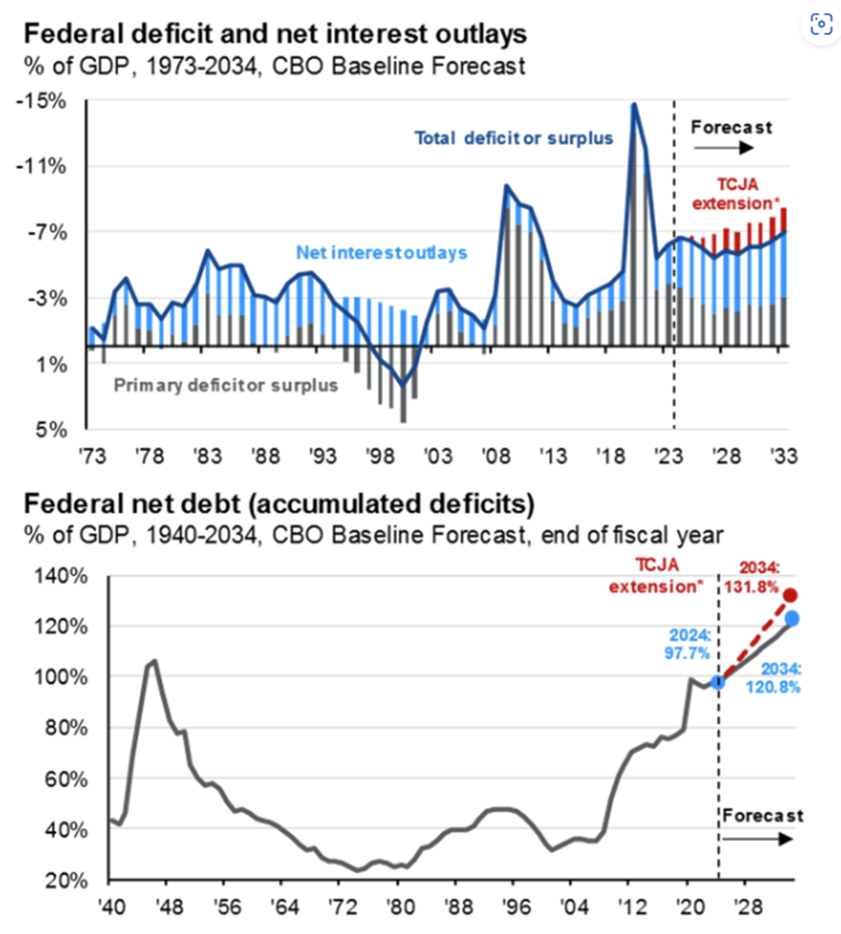
Source: JPMorgan Guide to the Markets
The Policy Outlook
There is little question among economists that the direct effect of tariffs would be an increase in consumer prices. At a fundamental level, tariffs on imports are a form of taxation; those higher prices are naturally born by consumers. There is an open question of how large the tariffs will be that the administration might implement, but the higher they are, the greater their inflationary impact is likely to be.
Whether one agrees or disagrees with the use of tariffs to protect American industry is a political view; there is no right or wrong answer. However, economic logic suggests that, all things equal, higher inflation will lead the Fed to raise interest rates; higher interest rates would result in higher interest for the federal government (interest on our debt outstanding); which would subsequently lead to still higher deficits. Higher interest rates would also be a headwind for consumers and may therefore (likely) lead to lower gross domestic product growth.
Takeaways
As we said at the outset, our intention here isn’t to praise or denigrate either candidate. What’s important is to remember our recurring theme that politics and investing don’t mix.
Moving past the election, we believe it’s important to keep three lessons in mind:
1. Equity markets have done well over the long-term. This has been the case under both Republican and Democratic administrations. Markets have increased most years, and the economy has grown most years. Downturns are inevitable, but when they will occur is hard to predict and trying to time the market has been a fool’s errand.
2. Keep politics out of your portfolio. It is tempting to think that our preferred political outcome should lead to better returns and that, conversely, our undesired electoral outcome will lead to poor returns. If only markets were that simple. Picking winners and losers based on electoral outcomes is virtually impossible. Companies and sectors that initially appear in favor do not always remain so. The best strategy – the one we articulated before the election and continue to advocate today – is to remain fully invested in a broadly diversified portfolio that’s aligned with your family’s need, tolerance, and capacity to assume financial risk.
3. Check your family’s financial plan. Finally, it’s wise to work closely with your advisor to make sure that your family’s financial plan is well positioned to respond to or capitalize on any potential changes in tax laws.
Visit the Mercer Advisors website for past insights from our CIO about the impact of the election on markets and other interesting topics. Not a Mercer Advisors client but interested in more information? Let’s talk.