
Introduction
A concentrated stock position can be both a sign of success and a source of risk. Whether your position grew from years of equity awards, a successful IPO, or a long-held investment that appreciated significantly, having too much of your net worth tied to a single stock introduces volatility and uncertainty. Concentrated stock diversification offers multiple paths to help reduce that risk while managing taxes.
One challenge is that, while reducing risk is practical, selling triggers capital gains tax that can take a significant bite out of your wealth. The good news is that you have more options than a sell-and-pay-taxes approach.
This guide walks through nine established concentrated stock diversification strategies, how they compare, and how to identify the right combination for your situation.
Why Concentrated Stock Positions Need a Plan
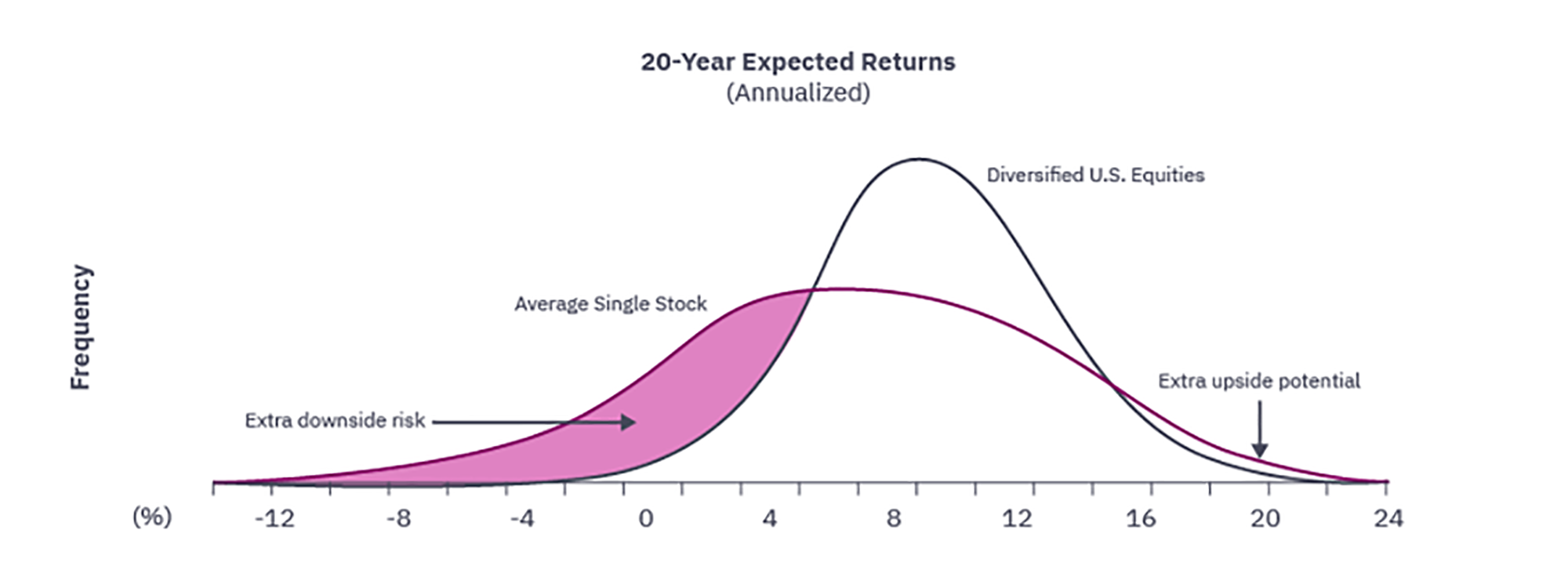
When a single stock represents a large percentage of your portfolio, its performance dominates your overall returns. A concentrated position may remove the protection that diversification provides. If the company has a strong run, you can benefit more than a diversified investor would — but if it has a bad year or a bad decade, nothing else in your portfolio may be able to absorb the hit.
Diversification means investing in a variety of assets to lower the overall risk of your portfolio, often easier to achieve through mutual funds or exchange-traded funds (ETFs) rather than individual stocks.
The risk is notable. Many concentrated positions come from company stock, which means your income and your investments are tied to the same company. If the company struggles, both your paycheck and your portfolio could suffer at the same time.
The Decision Framework: Position Size, Embedded Gain, and Your Goals
No single strategy fits every situation. The right concentrated stock diversification approach may depend on three key factors:
- Position size: How much of your total portfolio does the stock represent? A larger position may call for more aggressive risk reduction.
- Embedded gain: How much unrealized capital gain is in the position? A low basis means a bigger tax bill on sale, which may point toward strategies that defer taxes.
- Your goals: Do you need liquidity now, want to preserve upside, plan to give charitably, or want to transfer wealth to heirs? Each goal leads to a different strategy or combination.
Nine Diversification Strategies Compared
1. Direct sale
Selling shares outright is the most straightforward approach. You sell portions of your position over time and reinvest the proceeds into a diversified portfolio. Spreading sales across several tax years keeps more of the gain out of your highest federal tax bracket each year.
The trade-off is taxes. Selling a large, appreciated position can trigger substantial capital gains. For example, at a federal rate of 20% plus the 3.8% net investment income tax (NIIT), the combined rate reaches 23.8%.4
If you acquired your shares as an insider or through company equity awards, a 10b5-1 trading plan can automate the process. A 10b5-1 plan is a prearranged, written plan that sets when and how you can sell company stock, helping you comply with insider trading rules while diversifying on a regular schedule. Adopting the plan when you are not in possession of material nonpublic information is critical, and many companies require a cooling-off period before the first trade. Pairing a 10b5-1 plan with staged sales lets you reduce your position systematically rather than waiting for open trading windows.
2. Exchange funds for concentrated stock
An exchange fund is a private partnership that pools appreciated stock from multiple investors. You can transfer your shares and receive a proportional interest in the fund, which holds a diversified basket of stocks. Because the exchange is structured as a nontaxable transfer rather than a sale, you achieve capital gains deferral.5
The fund requires a seven-year holding period to receive the full diversification benefit. After that period, you can redeem your interest for a diversified basket of 25 to 30 stocks while keeping your original cost basis.6
Exchange funds typically suit investors with low-cost-basis positions, high tax rates, and minimal liquidity needs. The main drawback is the lockup — if you need cash before the seven years are up, you may not exit cleanly.
3. Direct indexing
Direct indexing lets you own individual stocks within an index rather than holding a fund. This structure creates opportunities for direct indexing tax-loss harvesting. You can sell individual stocks that have declined in value to realize losses, then use those losses to offset capital gains as you gradually sell down your concentrated position.
The strategy unfolds over five to 10 years. You can deposit cash alongside your concentrated stock, and the direct indexing account tracks a benchmark while generating offsetting losses.7 Even in years when the overall index is up, a meaningful number of individual stocks within it decline. Those declines become harvestable losses that help reduce your tax bill as you diversify.
4. Section 351 exchange
The IRS requires a control group of five or fewer participants and diversification tests: no more than 25% of assets in a single issuer and no more than 50% in five or fewer issuers.7
This approach offers tax deferral similar to an exchange fund but with a different structure. The rules are technical, and a Mercer Advisors wealth advisor and tax professional can help ensure the exchange is structured properly and aligned with your diversification and tax objectives.
5. Options collar strategy
An options collar pairs a protective put with a covered call on your concentrated stock. The put gives you the right to sell at a set price, limiting downside, while the call generates income that can offset the put’s cost. Together, they create a hedge that reduces risk without selling shares.
The trade-off is capped upside: The call limits your gains if the stock rises above the strike price. You also need to watch the constructive sale rule under IRC Section 1259. If a collar is structured too tightly, the IRS may treat it as a constructive sale, triggering taxes even if you have not sold the shares.
Collars are generally most effective for highly liquid stocks and investors who want immediate downside protection.
6. Charitable trusts and donor-advised funds for concentrated stock
If philanthropy is part of your plan, a charitable trust for concentrated stock can address both diversification and tax efficiency. A charitable remainder trust (CRT) lets you transfer appreciated stock, receive an income stream, and generate an immediate charitable deduction, all while the trust sells the stock without triggering capital gains at your level. A donor-advised fund (DAF) offers a more straightforward structure: You transfer stock, take an immediate deduction, and recommend grants to charities over time.
Both approaches help reduce your concentrated position while supporting causes you care about. A charitable trust concentrated stock strategy can also complement other approaches — for example, pairing a CRT with direct indexing to address both philanthropic goals and ongoing tax management.
The CRT provides ongoing income, making it suitable for investors who need cash flow, while the DAF offers flexibility and ease.
7. Forward contracts
A forward contract lets you agree to sell your concentrated stock at a set price on a future date. This provides certainty about the proceeds while deferring the actual sale, which can help you plan around tax years and manage timing. The contract is privately negotiated, so terms are flexible, but it also means less liquidity if your plans change.
Forward contracts can be most effective for investors who want to lock in gains without selling shares right away.
8. Variable prepaid forward contracts
A variable prepaid forward contract lets you receive cash now while deferring the sale of your concentrated stock. You receive an upfront payment and agree to deliver a variable number of shares at a future date, depending on the stock’s price at that time. This structure provides liquidity without triggering an immediate sale for tax purposes. Because the IRS has specific rules around these arrangements, coordination with a tax professional is important.
Variable prepaid forward contracts typically suit investors who need cash now but want to defer capital gains.
9. Stock gifts to family
Gifting appreciated stock to family can shift future growth out of your estate and reduce your concentrated position. You can transfer shares to children or other heirs, potentially moving the appreciation into their tax brackets. The annual gift tax exclusion and lifetime exemption set limits on how much you can transfer without gift tax consequences.
This approach complements other strategies — for example, using direct indexing or an exchange fund for the rest of your position.
The table below maps these three factors to recommended strategies. Your situation may call for a single strategy or a combination of several.
| Position size | Embedded gain | Your goal | Recommended strategy |
|---|---|---|---|
| Large | Low | Reduce risk, diversify | Direct sale (spread across tax years) |
| Large | High | Defer taxes, diversify | Exchange fund or Section 351 exchange |
| Large | High | Protect downside now | Options collar (paired with direct indexing) |
| Medium | High | Gradual diversification, manage taxes | Direct indexing (five to 10 years) |
| Any | High | Lock in gains, defer sale | Forward contract |
| Any | High | Get cash now, defer taxes | Variable prepaid forward contract |
| Any | High | Support charity, generate income | Charitable trust |
| Any | High | Support charity, flexibility | Donor-advised fund |
| Any | High | Shift growth to family, reduce estate | Stock gift to family |
| Any | Any | Comply with insider trading rules | 10b5-1 trading plan (paired with staged sales) |
Putting It Together: An Integrated Approach
Rarely can a single strategy solve the challenge of a concentrated position. Many investors benefit from combining two or three concentrated stock diversification strategies, coordinated across investment, tax, and estate planning.
For instance, an executive with a large low-basis position in company stock might pair an options collar for immediate downside protection with a direct indexing account that generates offsetting losses over time. As the position gradually unwinds, a 10b5-1 plan can automate prescheduled sales to comply with insider trading rules. If philanthropy is a goal, a charitable remainder trust or donor-advised fund can further help reduce the position while providing tax benefits.
The key is coordination. When your financial plan, investment strategy, tax planning, and estate plan work together, each decision reinforces the others. A comprehensive approach can help you reduce risk, manage taxes, and align your wealth with your goals.
Key Takeaways
A concentrated stock position introduces risk that concentrated stock diversification can help address, but the right strategy depends on your position size, embedded gain, and personal goals.
The nine strategies covered in this guide offer different trade-offs across risk reduction, tax management, and liquidity. Additional strategies not included here may be appropriate for your situation.
Remember that you may benefit from more than one strategy as part of a coordinated plan for achieving your financial goals.
Ready to start a conversation about your concentrated stock position?

FAQs
-
A concentrated stock position is when a single stock makes up a large percentage of your total portfolio. Advisors may flag risk when one position exceeds 5%-20% of your portfolio. The concern is that your overall returns become dominated by one company’s performance, removing the protection that diversification provides. If that company struggles, nothing else in your portfolio may be able to absorb the hit.
-
Direct indexing lets you own individual stocks within an index rather than a fund, which creates opportunities for tax-loss harvesting. If you sell stocks that have declined to realize losses, you can then use those losses to offset capital gains as you gradually sell down your concentrated position. The strategy typically unfolds over five to 10 years, depositing cash alongside your stock while the account tracks a benchmark and generates offsetting losses.
-
Selling all at once can trigger a large capital gains tax bill and is rarely the right approach on its own. Spreading sales across several tax years helps keep more of the gain out of your highest tax bracket each year. You can also pair staged selling with tax-loss harvesting or other strategies to reduce the tax impact. A Mercer Advisors wealth advisor can help you build a diversified sale schedule tailored to your tax situation and goals.
-
An exchange fund can be worth the commitment if you have a low-cost-basis position, a high tax rate, and minimal liquidity needs. The fund lets you defer capital gains while achieving instant diversification across a basket of stocks. After seven years, you can redeem for a diversified portfolio while keeping your original cost basis. If you might need liquidity before the lockup ends, an exchange fund may not be the right fit.
-
A 10b5-1 trading plan is a prearranged, written plan that sets when and how you can sell company stock. Executives and long-tenured personnel use it to sell shares on a regular schedule while complying with insider trading rules. It may be beneficial to coordinate with your company’s legal team and a Mercer Advisors wealth advisor. Your advisor can help structure the plan to align with your diversification timeline.
-
Both strategies defer capital gains, but they differ in structure. An exchange fund is a private partnership where multiple investors pool appreciated stock, with a seven-year holding period before you can redeem for a diversified basket. A Section 351 exchange transfers stock into a newly formed corporation or exchange-traded fund (ETF), requiring a control group of five or fewer participants and diversification tests limiting any single issuer to 25% and the top five to 50%.
-
They serve different purposes. Direct indexing can gradually reduce your position over years by generating tax losses to offset gains, making it ideal for patient investors who want to manage taxes over time. An options collar provides immediate downside protection by hedging the position without selling shares, but it caps your upside. It’s possible to combine them: direct indexing for multiyear diversification that manages taxes and a collar for near-term protection.
1“Do You Hold Too Much in One Investment?” Fidelity, Feb. 19, 2025.
2“How To Manage Stock Concentration Risk.” Charles Schwab, Apr. 10, 2026.
3“Investor.gov Tips for 2026 — Investor Bulletin.” U.S. Securities and Exchange Commission, March 31, 2026.
4“Topic No. 409, Capital Gains and Losses.” IRS.
5“Using Exchange Funds To Diversify Concentrated Securities (And When It’s Better To Sell Instead).” Kitces, April 29, 2026.
6“Tax-Efficient Ways To Diversify Concentrated Stock Positions.” Financial Planning Association, Oct. 2024.
7“Ways To De-Risk Concentrated Stock Portfolios.” Journal of Accountancy, April 1, 2026.
All expressions of opinion reflect the judgment of the author as of the date of publication and are subject to change. Some of the research and ratings shown in this presentation come from third parties that are not affiliated with Mercer Advisors. The information is believed to be accurate but is not guaranteed or warranted by Mercer Advisors. Content, research, tools and stock or option symbols are for educational and illustrative purposes only and do not imply a recommendation or solicitation to buy or sell a particular security or to engage in any particular investment strategy. All investing involves risk, including the possible loss of principal. Different types of investments involve varying degrees of risk, investments mentioned in this document may not be suitable for all investors. Investments are subject to market risk, including the possible loss of principal. All investment strategies have the potential for profit or loss. Changes in investment strategies, contributions or withdrawals may materially alter the performance and results of your portfolio. Portfolio management strategies such as diversification, asset allocation, and rebalancing do not ensure a profit or guarantee against loss. Hypothetical examples are for illustrative purposes only.
For financial planning advice specific to your circumstances, talk to a qualified professional at Mercer Advisors.
Mercer Advisors is not a law firm and does not provide legal advice to clients. All Estate planning document preparation and other legal advice are provided through select third parties, with which Mercer Advisors has a contractual relationship. Tax preparation and filing services are provided by Mercer Advisors Tax Services, LLC. Clients will sign a separate agreement when engaging Mercer Advisors Tax Services that defines the services provided and any additional fees that may apply. Insurance products are provided by Mercer Advisors Insurance Services, LLC (MAIS), which places individual life, disability, long term care coverage, and property and casualty coverage through select insurance companies. Trustee services are offered through select third parties with which a client would sign an additional agreement, and additional fees may apply.