
Introduction: How Retirement Changes Your Tax Picture
The end of a paycheck doesn’t mean the end of taxes. When you stop working, your earned income may disappear, but the assets you have spent decades accumulating still generate tax obligations — sometimes in ways that surprise even experienced investors.
During your working years, your tax picture was relatively straightforward. You earned income, your employer withheld taxes, and you filed annually. In retirement, the mechanics change. Your income may come from multiple sources, and each has its own tax treatment. Your income sources may include Social Security, pension payments, IRA withdrawals, investment income, and rental or business income. The interaction between these sources can push you into higher brackets than you expected, trigger Medicare surcharges, or make more of your Social Security benefits taxable.
The key insight is that retirement tax planning is about making strategic decisions throughout the year that shape what you may owe. Acting before Dec. 31, not by April 15 of the following year, can make a meaningful difference. By the time you file, nearly every decision that determines your tax liability has already been made.
Understanding Your Effective vs. Marginal Rate in Retirement
Two tax rate concepts matter more in retirement than they did during your working years: your effective rate and your marginal rate. Understanding the difference between these tax rates can be an important consideration in retirement tax planning.
- Your effective tax rate is the overall percentage of your total income that goes to taxes. It’s a blended rate that accounts for every bracket your income passes through.
- Your marginal rate is the rate you pay on your next dollar of income — the top bracket you’re in.[
Why your marginal rate matters more
In retirement, your marginal rate drives many of your most important decisions. When you’re deciding whether to take an extra withdrawal, do a Roth conversion, or realize a capital gain, the cost of that decision is measured at your marginal rate, not your effective rate. A retiree with an effective rate of 12% might face a marginal rate of 22% or higher on additional income, which changes the calculation significantly.
This distinction may become especially important when you’re managing the transition from pretax accounts to Roth accounts, sizing charitable contributions, or timing the recognition of capital gains. Each decision should be evaluated at the margin. What does the next dollar cost you in taxes, and what does it cost in downstream effects like income-related monthly adjusted amount (IRMAA) surcharges or Social Security taxation?
Roth Conversion Strategy: The Notch Years
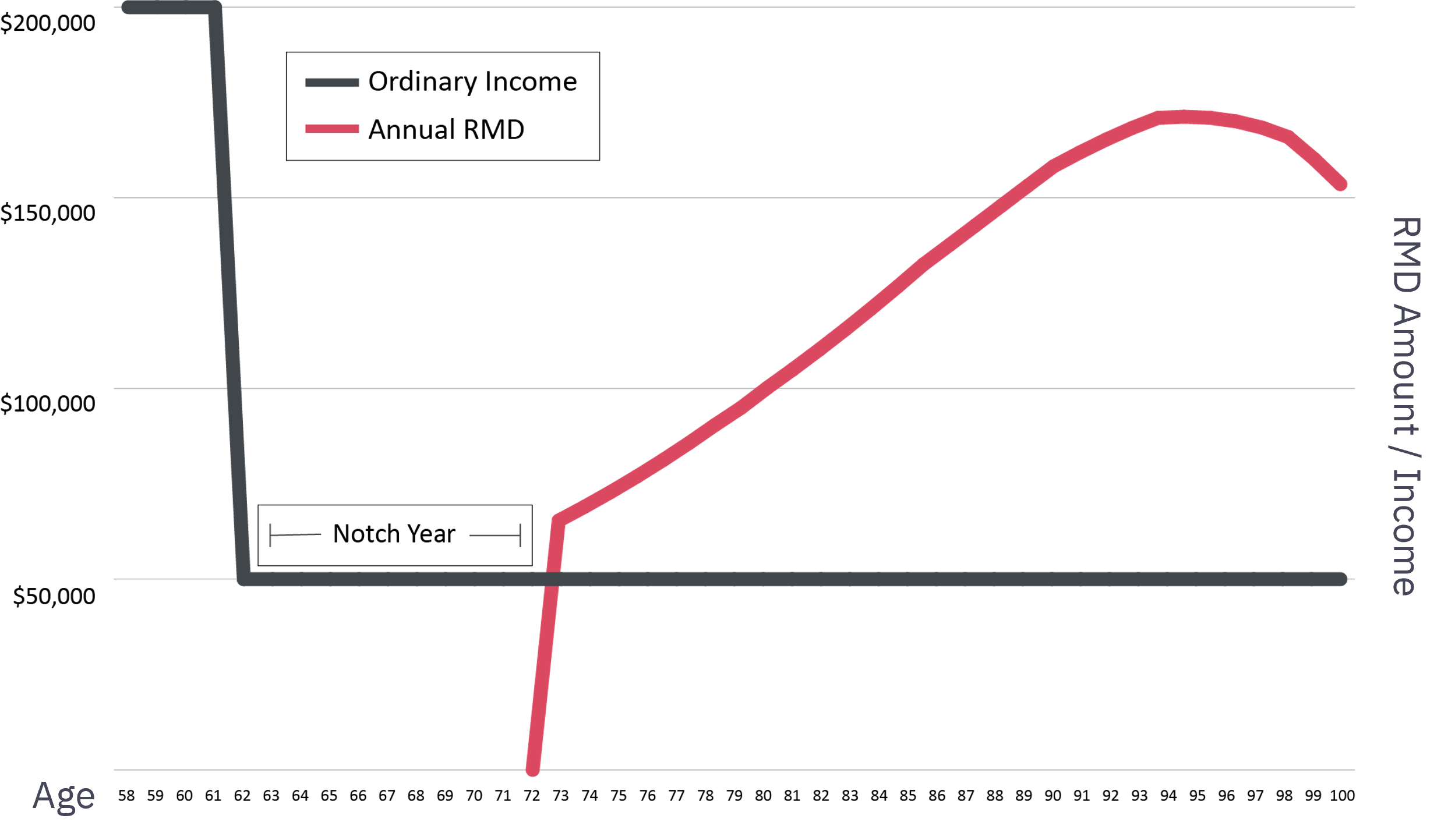
In some cases, the most valuable window for retirement tax planning is the period between retirement and the start of required minimum distributions (RMDs). These “notch years” represent a brief period when your taxable income may be unusually low — and potentially the lowest it may be for the rest of your life.
When you retire and your earned income stops, Social Security may not have begun or may represent a modest base. RMDs haven’t kicked in. And while your assets are intact, your taxable income for that window may be much lower than during your working years. This gap represents an opportunity to convert pretax retirement funds to Roth accounts at lower tax rates than you paid while working. Those rates could also be lower than your heirs may pay on an inherited traditional IRA.
Strategic Roth conversions during the notch years may help reduce taxable income for both you and your heirs. Each dollar converted and taxed today reduces the pretax balance that ultimately drives RMDs and, therefore, your own mandatory taxable income starting at age 73. It also reduces the inherited pretax balance your heirs may face, potentially replacing it with a Roth balance that grows and distributes tax-free.
The notch years opportunity window
The gap between your last paycheck and your first required distribution, typically ages 62 to 73, is a powerful window for Roth conversions, income management, and IRMAA bracket control.
Performance quoted is past performance and is not indicative of future results. For Illustrative Purposes Only
The inherited IRA rule
Under rules established by the SECURE Act, nonspouse beneficiaries who inherit a traditional IRA are generally required to fully distribute the account within 10 years. For families with significant pretax balances, this means children who inherit those accounts may be forced to take large, fully taxable distributions during their own peak earning years — a time when they may be least likely to want additional ordinary income.
Roth conversions done during the notch years may help address this issue on two levels:
- They reduce the pretax balance that drives future RMDs.
- They convert taxable inherited assets into tax-free Roth assets for your heirs.
RMDs and Bracket Management
Required minimum distributions begin at age 73 for most retirees, or age 75 for those born in 1960 or later. These mandatory withdrawals from traditional IRAs, 401(k)s, and other pretax accounts are taxed as ordinary income. They can push you into a higher bracket than you occupied during your notch years.
The challenge with RMDs is that you don’t control the amount. The IRS calculates your RMD based on your account balance and life expectancy, and you must withdraw at least that amount each year. If your RMDs are large enough to push you into a higher bracket, you may pay more in taxes than necessary — even on income you may not need.
Retirement tax planning addresses this by using Roth conversions during the notch years to help reduce the pretax balance that drives RMDs. By converting strategically before RMDs begin, you may be able to manage your bracket more effectively and reduce the mandatory taxable income that arrives later.
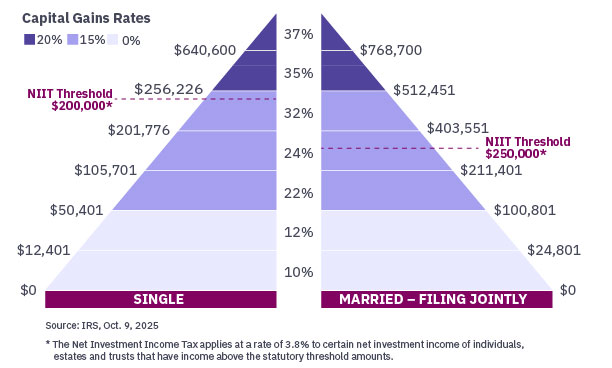
2026 Tax Rate Pyramid
Qualified Charitable Distributions (QCDs)
If you are age 70 ½ or older, you may direct up to $111,000 per year (for 2026) from your IRA directly to a qualified charity.7 A qualified charitable distribution transfers the IRA funds to charity without ever adding to your income. Therefore, you pay no income tax on the distribution, regardless of whether you itemize.
At higher income levels, a QCD is generally more tax-efficient than taking the IRA distribution as income and then deducting the charitable contribution.
A QCD can also count toward your annual RMD, reducing your mandatory taxable income for the year.
For retirees with significant IRA balances and charitable intent, QCDs are one of the most powerful tools in retirement tax planning.
Tax-Loss Harvesting
In a taxable brokerage account, positions that have declined in value may be sold to realize a capital loss — which can offset realized capital gains and up to $3,000 of ordinary income annually. Excess losses are carried forward indefinitely. When done consistently throughout the year, tax-loss harvesting may meaningfully help reduce the tax drag on your portfolio over time.
Effective approaches use technology to identify harvesting opportunities throughout the year, not just in December when the best opportunities may already be limited. Capital loss carryforwards are an asset on your tax return and should be tracked, protected, and deliberately .
Tax-Loss Harvesting To Reduce Your Tax Bill
The ideal outcome is using your investment losses to decrease your tax bill.
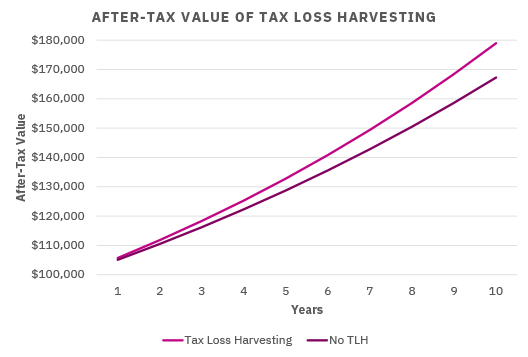
Assumes $100,000 starting value, 6% overall growth (9% on half theportfolio and -3% on the other half), 35% tax savings on the lossharvesting against short-term capital gains and ordinary income, 15% long-term capital gains rate upon liquidation. Any tax savings are assumed to be reinvested into the account and deductible losses reduce portfolio basis. For illustrative purposes only.
Coordinating Your Year-Round Tax Strategy
The strategies described in this guide all share one critical characteristic: They must happen before Dec. 31 to be effective, not April 15 of the next year. The filing deadline confirms what you have already done. The planning work is what helps determine whether what you have done was optimal.
Effective retirement tax planning should have coordination across your entire financial picture: investments, retirement accounts, charitable giving, estate planning, and healthcare costs.
Do you have a complex financial picture? Significant investment assets, business interests, retirement accounts, or estate planning needs? A coordinated approach between a CPA or tax-planning professional and a financial advisor may help produce different outcomes than either relationship alone.
At Mercer Advisors, our tax planning and preparation service considers your broader financial picture year-round and makes forward-looking recommendations that can help influence your tax outcomes before the year closes. We offer integrated financial planning, investment management, tax planning and preparation, estate planning, insurance solutions, and more.

FAQ’s
-
Retirement tax planning is a forward-looking process that involves analyzing your financial situation and implementing strategies throughout the year to help reduce the taxes you may owe. Tax filing, by contrast, is the annual process of reporting past financial activity to comply with IRS requirements. By the time you file, nearly every decision that shapes your tax liability has already been made. Planning influences what you may owe while filing records what you already owed.
-
A Roth conversion moves money from a traditional IRA or 401(k) into a Roth IRA. You pay ordinary income tax on the converted amount in the year of the conversion, but all future growth and qualified withdrawals are tax-free. The strategy is likely to be most valuable when your income is temporarily lower — such as during the notch years between retirement and required minimum distributions — because you may convert at a lower tax rate than you paid during your working years.
-
A Roth conversion may make sense if you’re in a period of lower taxable income, such as the years between retirement and the start of required minimum distributions (RMDs). The decision depends on your current marginal tax rate, your expected future rate, and downstream effects like income-related monthly adjustment amount (IRMAA) surcharges and Social Security taxation. Running the numbers with a wealth advisor can help you determine whether paying tax today at known rates is preferable to paying tax later at uncertain rates.
-
Tax-loss harvesting may be worthwhile for retirees with taxable brokerage accounts, particularly those with realized capital gains to offset. By selling positions that have declined in value, you can offset gains and up to $3,000 of ordinary income annually, with excess losses carried forward indefinitely. The strategy is often most effective when done systematically throughout the year, not just at year-end when opportunities may be compressed.
-
You can calculate your RMD by dividing your traditional IRA or 401(k) account balance as of Dec. 31 of the prior year by your life expectancy factor from the IRS Uniform Lifetime Table. RMDs begin at age 73 for most retirees, or age 75 for those born in 1960 or later. Your financial advisor or tax professional can help you calculate the exact amount and ensure you meet the Dec. 31 deadline to avoid penalties.
-
A qualified charitable distribution (QCD) is made directly from your IRA to a charity and never flows through your income — meaning you pay no income tax on the distribution, regardless of whether you itemize. A regular charitable deduction requires you to take the income, pay the tax, donate the cash, and then deduct it subject to AGI limits. For retirees over age 70 ½ with significant IRA balances, a QCD is generally more tax-efficient, and it may also count toward your annual RMD.
-
Your effective tax rate is the overall percentage of your total income that goes to taxes — a blended rate across all brackets. Your marginal rate is the rate you pay on your next dollar of income — the top bracket you are in. In retirement, your marginal rate drives many important decisions, such as whether to do a Roth conversion or take an extra withdrawal. A retiree with a 12% effective rate might face a 22% marginal rate on additional income, which changes the calculus significantly.