
What Is Tax-Loss Harvesting and Why Does It Matter for Your Portfolio?
If you have built meaningful wealth, you likely already understand the fundamentals of tax-loss harvesting:
- Sell an investment that has declined in value.
- Realize the loss for tax purposes.
- Use that loss to offset capital gains — or up to $3,000 of ordinary income each year.
- Reinvest in a similar security at the same time.
Unused losses carry forward indefinitely, creating a growing reservoir of tax benefits you can deploy in future years.
What separates a basic year-end harvest from a strategy that compounds value over time is the depth and frequency with which you apply it.
The stakes may be higher and the opportunities may be larger if you have concentrated positions, capital gains from business sales, real estate transactions, or equity awards. Each of these creates gains that harvested losses can offset.
The result is what is known as “tax alpha” — the after-tax return enhancement that comes from systematically realizing tax losses. More direct holdings increase the ability to capture losses symmetrically, which has given rise to direct indexing. Direct indexing has grown into a mainstream capability for wealth management, with assets closing out 2024 at $864.3 billion — nearly double the level reported in 2021.1,2 A 2026 FTSE Russell survey found that 83% of advisors are using or plan to use direct indexing in the next 12 months, and 42% cite tax efficiency and tax-loss harvesting as the primary reason for increasing their use.3
Direct Indexing: The Engine Behind Systematic Tax-Loss Harvesting
How direct indexing functions
Instead of buying an exchange-traded fund (ETF) or mutual fund that tracks an index, investors own the individual stocks that make up that index directly in a separately managed account (SMA). This structure lets you sell specific positions that have declined while buying similar — but not substantially identical — replacements to keep your market exposure steady. Because even in a rising market, individual stocks within an index may decline, and harvesting opportunities are available every year, not just during downturns.
The tax-alpha math
Research published in 2026 found that systematic tax-management techniques — including tax-loss harvesting, gain deferral, and tax-aware rebalancing — produce implied annualized tax alpha typically in the range of 0.7% to 3.5% for equity direct indexing.4 Industry data points to a range of 1% to 2% annually (per the chart below), although results vary based on market conditions, tax rates, and the investor’s specific circumstances.
The value of those harvested losses depends on what they offset. A loss that offsets short-term capital gains taxed at your ordinary income rate is worth more than one that offsets a long-term gain taxed at a lower rate. For investors in the top federal tax bracket who also pay the 3.8% net investment income tax (NIIT) and state tax, every dollar of harvested loss can save 30 cents or more on the dollar in taxes. Those savings compound over time, especially when fresh deposits create new tax lots with higher cost basis — generating still more harvesting opportunities.
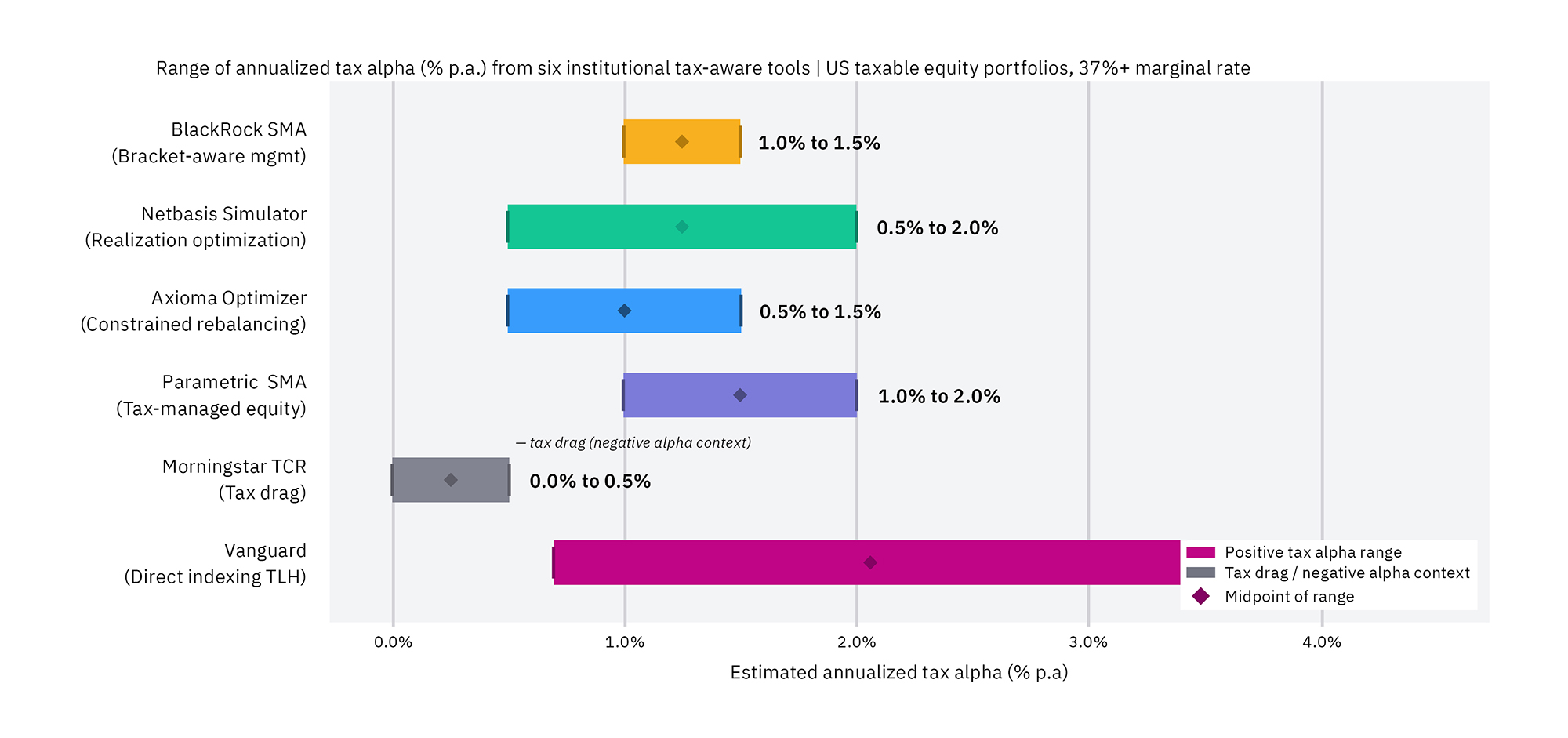
Source: Wiśniewski, P. (2026). “Tax-Adjusted Performance Metrics: Integrating Tax Planning Into Risk-Adjusted Portfolio Evaluation.” Journal of Management and Financial Sciences, (59), 9–23. SCH Warsaw School of Economics. Data from Table 2: Tax-alpha estimates from industry simulation tools (Vanguard, Morningstar, Parametric, Axioma, Netbasis, BlackRock).
Direct indexing vs. ETFs and mutual funds
One study found that direct indexing often outperforms ETFs for tax-sensitive investors, particularly over shorter investment horizons and when deposits are recurring rather than a lump sum.5 ETFs largely eliminate capital gains through in-kind redemptions, but they cannot harvest losses at the individual security level. That is the structural advantage direct indexing offers: You control which lots to sell, when to sell them, and what to replace them with. Over the past two decades, U.S. equity mutual funds have distributed capital gains averaging roughly 7%-9% annually, creating tax drag that direct indexing can help reduce.6
Wash-Sale Rules: Issues To Watch Across Multiple Accounts
The 61-day window and “substantially identical” rule
The IRS wash-sale rule, codified in Internal Revenue Code Section 1091 and described in IRS Publication 550, disallows a capital loss if you buy the same or a “substantially identical” security within 30 days before or after the sale — a 61-day window in total. The rule follows you, the taxpayer, not your brokerage account. That means selling a stock at a loss in one account and rebuying it in another within the window still triggers the rule, even if neither broker reports it on Form 1099-B.
The IRA issue: Permanent loss of the deduction
One of the most costly wash sales can often occur across taxable and retirement accounts.
If you sell a security at a loss in a taxable account and buy the same or a substantially identical security in your IRA or Roth IRA within the 61-day wash-sale window, the loss is disallowed. Unlike a typical wash sale involving taxable accounts, however, the disallowed loss does not increase the basis of the investment in the IRA or Roth IRA, so you generally lose the tax benefit of that loss. It is permanently forfeited. The same result applies to a buy in your spouse’s IRA.
Automatic features like dividend reinvestment plans can inadvertently trigger a wash sale if the same security is sold at a loss within 30 days.
Coordinating across household accounts
Because brokers are only required to report wash sales within individual accounts, you’re responsible for tracking cross-account wash sales yourself. This is where the coordinated approach Mercer Advisors offers can be beneficial. When your investment management and tax planning are handled by one team that knows your full financial picture, that team can help you harvest losses across accounts without accidentally running afoul of the rule.
Three Integrated Strategies That Go Beyond Harvesting
Tax-loss harvesting can be most useful when it’s not a stand-alone exercise but part of a comprehensive plan. Here are three ways to coordinate harvesting with other planning strategies across tax, investment, estate, and charitable giving.
1. Pair harvested losses with charitable giving of appreciated stock
When you harvest losses, you are selling positions that declined. At the same time, you may hold positions that have appreciated significantly. Instead of selling those winners and paying capital gains tax, you can gift the appreciated shares directly to a qualified charity or a donor-advised fund (DAF). You can avoid the capital gains tax on the embedded gain and receive a charitable deduction for the full fair market value. Meanwhile, the losses you harvested offset gains from other transactions. The two strategies complement each other: Losses offset gains, and charitable gifts remove gains from your portfolio entirely.
This pairing can be especially helpful for investors with concentrated positions who want to diversify their portfolios while supporting causes they care about. By gifting appreciated stock, you can reduce your concentrated position without recognizing the gain — and by harvesting losses elsewhere, you may further reduce your overall tax liability.
2. Use direct indexing to unwind concentrated positions tax-efficiently
If you hold a large position in a single stock with a low cost basis, selling it all at once can trigger a significant capital gains tax. Direct indexing lets you unwind that position over five to 10 years, selling portions gradually and using the losses harvested from the diversified portfolio to offset the gains from each sale. This coordinated approach can help reduce the tax impact of diversification and support a more balanced portfolio over time.
As the concentrated position is sold down, the portfolio becomes increasingly diversified, and the losses generated by the direct indexing strategy continue to offset gains from each tranche of the sale. This is an example of how investment management and tax planning can reinforce each other.
3. Coordinate harvesting with Roth conversions and rebalancing
Roth conversions create taxable ordinary income in the year you convert. If you have harvested losses available, they can offset capital gains realized during any rebalancing, freeing room to convert more assets to a Roth IRA at a lower tax cost. Similarly, when you rebalance your portfolio to restore your target allocation, the sales that generate gains can be paired with harvested losses to reduce the tax impact. Additionally, you can use up to $3,000 of capital losses to offset the ordinary income from the Roth conversion.
The key insight is that each of these strategies — harvesting, charitable giving, concentration management, Roth conversions, and rebalancing — creates tax consequences on its own. When they’re coordinated, those consequences can be managed together, and the result can be greater than the sum of the parts.
Is Direct Indexing Right for Your Portfolio?
Direct indexing is generally most effective for investors with meaningful taxable account balances, high marginal tax rates, and regular capital gains from other sources. If you have concentrated stock positions, anticipate a business sale or liquidity event, or make regular deposits to your taxable accounts, the strategy can generate more harvesting opportunities over time. It’s also well suited for investors who want to make their portfolios more personal — excluding specific sectors, incorporating values-based screens, or managing around existing holdings to avoid duplication.
The benefits may be quantifiable but depend on individual circumstances, so an analysis tailored to your situation is essential before implementation. Not every investor needs direct indexing and, for some, tax-managed funds or exchange-traded funds (ETFs) may be a more appropriate starting point. The right answer depends on your portfolio size, tax situation, and goals.
Putting It All Together With Coordinated Planning
Tax-loss harvesting through direct indexing is a powerful tool, but it can deliver more value when it’s coordinated with your tax planning, estate strategy, charitable goals, and investment management. When one team knows your full financial picture, every loss harvested, every position sold, and every gift made can fit into a larger strategy designed to protect and grow what you have built.
Our team can assess your portfolio, identify harvesting opportunities, and build a coordinated plan that aligns your investments with your goals and your family’s future.
Ready to explore whether direct indexing and advanced tax-loss harvesting fit your situation?

FAQs
-
Tax-loss harvesting is a strategy where you sell investments that have declined in value to realize a capital loss for tax purposes. You can use that loss to offset capital gains from other investments and up to $3,000 of ordinary income each year, with any unused losses carrying forward indefinitely. After selling, you can reinvest in a similar but not substantially identical security to keep your market exposure while capturing the tax benefit.
-
Direct indexing means owning the individual stocks that make up an index in a separately managed account (SMA) rather than buying an exchange-traded fund (ETF) or mutual fund. Because you own each stock directly, you can harvest losses at the individual security level — selling specific positions that have declined and replacing them with similar securities.
-
Direct indexing may be worth considering if you have a meaningful taxable portfolio, a high marginal tax rate, and regular capital gains from other sources such as concentrated stock, real estate, or business sales. The strategy can be effective when losses offset gains taxed at higher rates. An analysis with a Mercer Advisors wealth advisor can help you determine whether the potential tax alpha justifies the approach for your situation.
-
Although you can harvest losses on your own, a Mercer Advisors wealth advisor may add value by coordinating harvesting across all your accounts, monitoring wash-sale rules, and integrating losses with your broader tax, estate, and charitable planning. Cross-account wash sales are your responsibility to track, and brokers report only those within a single account. Professional coordination can help you avoid costly mistakes and maximize the after-tax benefit.
-
Mercer Advisors offers consultation with a wealth advisor who can explain how direct indexing functions, assess your portfolio, and help you determine whether the strategy fits your financial goals and tax situation.
-
Exchange-traded funds (ETFs) track an index as a single fund and cannot harvest losses at the individual stock level. Direct indexing lets you own each stock separately, so you can sell specific losers and replace them with similar securities while staying invested in the index. This security-level harvesting can generate additional after-tax returns that an ETF structure cannot offer, although direct indexing may involve higher fees and requires a larger minimum investment.
-
Tax-managed funds use strategies like low turnover and loss harvesting at the fund level, but you do not control which securities are sold or when. Direct indexing gives you individual security ownership, so losses are harvested at the stock level and can be coordinated with your personal tax situation, charitable giving, and concentrated positions. It offers more personal control, while tax-managed funds may be less complex and require a lower minimum investment.
1“Wall Street Calls It “Tax Alpha.” It’s a $1 Trillion Machine for Beating the IRS Instead of the Market.” Yahoo! Finance, Aug. 21, 2026.
2“Direct Indexing Assets Close Year-End 2024 at $864.3 Billion.” Cerulli Associates, April 10, 2025.
3“Direct Indexing Now Mainstream but There Are Still Barriers to Widespread Adoption, FTSE Russell Survey Finds.” InvestmentNews, Sept. 15, 2026.
4“The Tax-Adjusted Performance Metrics: Integrating Tax Planning Into Risk-Adjusted Portfolio Evaluation.” Journal of Management and Financial Sciences, March 30, 2026.
5“Direct Indexing and the Limits of ETF Tax Efficiency.” Harvard Business School, April 2026.
6“Capital Gains SZN Heats Up: What Investors Could Expect.” Advisor Perspectives, Dec. 13, 2025.
All expressions of opinion reflect the judgment of the author as of the date of publication and are subject to change. Some of the research and ratings shown in this presentation come from third parties that are not affiliated with Mercer Advisors. The information is believed to be accurate but is not guaranteed or warranted by Mercer Advisors. Content, research, tools and stock or option symbols are for educational and illustrative purposes only and do not imply a recommendation or solicitation to buy or sell a particular security or to engage in any particular investment strategy. All investing involves risk, including the possible loss of principal. Different types of investments involve varying degrees of risk, investments mentioned in this document may not be suitable for all investors. All investment strategies have the potential for profit or loss. Changes in investment strategies, contributions or withdrawals may materially alter the performance and results of your portfolio. Portfolio management strategies such as diversification, asset allocation, and rebalancing do not ensure a profit or guarantee against loss.
Mercer Advisors is not a law firm and does not provide legal advice to clients. All Estate planning document preparation and other legal advice are provided through select third parties, with which Mercer Advisors has a contractual relationship. Tax preparation and filing services are provided by Mercer Advisors Tax Services, LLC. Clients will sign a separate agreement when engaging Mercer Advisors Tax Services that defines the services provided and any additional fees that may apply. Insurance products are provided by Mercer Advisors Insurance Services, LLC (MAIS), which places individual life, disability, long term care coverage, and property and casualty coverage through select insurance companies. Trustee services are offered through select third parties with which a client would sign an additional agreement, and additional fees may apply.
For financial planning advice specific to your circumstances, talk to a qualified professional at Mercer Advisors.