

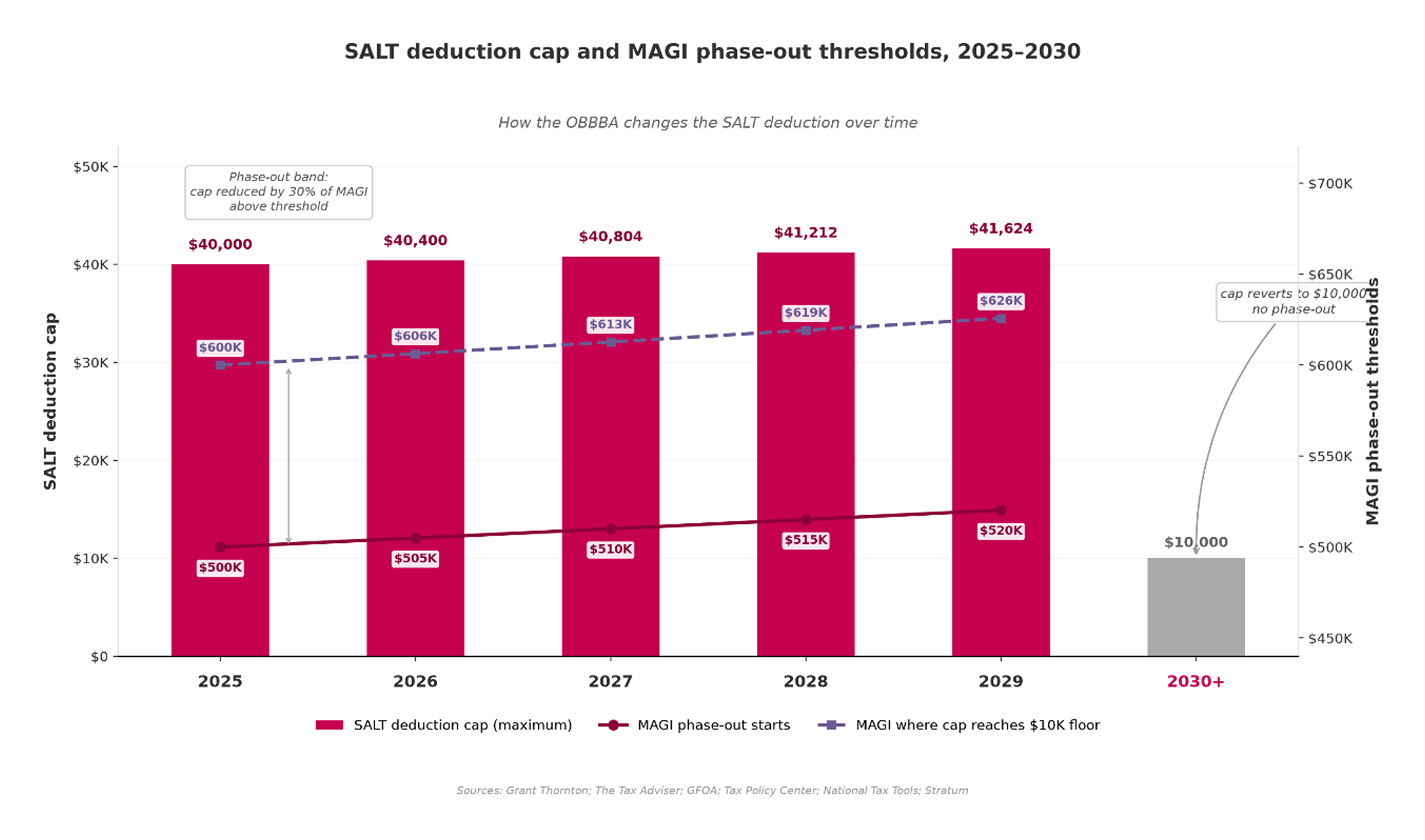
The One Big Beautiful Bill Act (OBBBA), signed into law July 4, 2025, brought long-awaited changes to the state and local tax (SALT) deduction cap, raising it from $10,000 to as high as $40,000 for 2025 through 2029. For families with established wealth in high-tax states, this increase can offer meaningful tax relief — but it comes with a catch. A phase-out based on modified adjusted gross income (MAGI) above $500,000 narrows the benefit for higher earners, making proactive planning essential.1
Understanding how the SALT deduction cap works, and what strategies may help you manage the phase-out, can give you insight into how you might capture more of the deduction while it’s available.
How the new SALT deduction cap works
For married couples filing separately, the cap is halved: $20,000 in 2025, with corresponding annual increases.
The SALT deduction cap applies to state and local taxes deducted on Schedule A. Taxpayers can generally deduct either state and local income taxes or sales taxes, along with eligible real estate and other local taxes paid during the year.
If you live in one of the 41 states that impose individual income tax, the expanded cap could allow you to deduct more of your state and local tax payments — at least through 2029.How the MAGI phase-out works
Here is where planning can become critical.
In practical terms, when a taxpayer’s 2025 MAGI reaches $600,000, the cap effectively returns to $10,000 — the same limit that was in place before the OBBBA.4 The threshold also increases by 1% annually: $505,000 in 2026, $510,050 in 2027, $515,151 in 2028, and $520,302 in 2029.5
This phase-out may create a planning challenge for families whose income fluctuates near the threshold. A year with a large capital gain, bonus, or business distribution could push your MAGI above $500,000 and reduce your SALT deduction.
Important exceptions for maximizing SALT deductions
Under the OBBBA, property taxes paid on business-use and rental properties remain fully deductible as a business expense. Cash-basis taxpayers can generally deduct the full amount paid during the year on the business return. This means that if $25,000, for example, was paid in assessed taxes for a large rental property, the entire amount is allowed as a deduction and is not subject to the SALT cap.
The PTET work-around: Preserved and relevant
Another outcome of the OBBBA for business owners was the preservation of the pass-through entity tax (PTET) work-around.
More than 35 states have enacted PTET regimes, though details and deadlines vary by state. Check with your tax professional each year for up-to-date information on whether this is applicable.
Even with the expanded $40,000 cap, PTET elections remain meaningful for business owners whose state tax burden exceeds the cap or whose MAGI places them in the phase-out range.



Four planning strategies to consider
1. Bunching and timing
Bunching — which is concentrating deductible payments into a single year — can help you maximize the SALT deduction cap in years when your income falls below the phase-out threshold. For example, if you expect your MAGI to be lower in one year, you might prepay property taxes or state estimated tax payments (if assessed and due) to capture the full $40,000 deduction.
Conversely, deferring income to a lower-MAGI year can help keep you below the phase-out threshold and preserve the higher cap. This might mean timing a business sale, deferring a bonus, or spreading capital gains across multiple tax years.
2. Entity restructuring
For business owners, the choice of entity structure affects how the SALT deduction cap applies. An S corporation or partnership can elect PTET, transforming what would be a limited individual SALT deduction into an unlimited business deduction. Reviewing your entity structure — especially if you’re considering a change — should account for both the SALT deduction cap and PTET availability in your state.
3. Residency considerations
Changing your state of domicile can reduce your overall state tax burden, but it requires genuine relocation — not just a paper change. States scrutinize residency changes, particularly for high earners. If you’re considering a move to a lower- or no-tax state, document your intent thoroughly and be prepared to demonstrate physical presence.
4. Coordinating with your broader financial plan
The SALT deduction cap does not exist in isolation. Income timing decisions that affect your MAGI — such as Roth conversions, harvesting capital gains and losses, or deferring compensation — can influence whether you benefit from the expanded cap or fall into the phase-out range.
Coordinating tax planning with investment and estate planning can help you manage your MAGI strategically. For example, ordinary deduction planning in a year when you are near the threshold could reduce your MAGI and preserve more of the SALT deduction. This is where a comprehensive and tailored wealth management approach that includes financial planning, investment management, tax planning and preparation, and estate planning can help create meaningful value.
A five-year planning window
The expanded SALT deduction cap is temporary. After 2029, the cap reverts to $10,000, making the 2025-2029 period a planning window for increasing your annual itemized deductions. Strategies that help you capture the full deduction now, while also positioning you for the lower cap in 2030, can create meaningful tax savings during this time.
Reviewing your situation annually before year-end — rather than waiting until next tax season — can help ensure you’re making decisions while opportunities are still available. Each year’s income, state tax liability, and PTET eligibility may shift, and a forward-looking plan can help you adapt.
Mercer Advisors offers comprehensive wealth management solutions.

FAQs
-
The One Big Beautiful Bill Act (OBBBA) raised the state and local tax (SALT) deduction cap from $10,000 to $40,000 for tax year 2025 with 1% annual increases through 2029 — reaching $41,624 — before reverting to $10,000 in 2030. The cap applies to itemized deductions on Schedule A, covering state and local income taxes, property taxes, and either general sales taxes or income taxes.
-
For taxpayers with modified adjusted gross income (MAGI) above $500,000, the state and local tax (SALT) deduction cap is reduced by 30% of the excess over that threshold. The deduction cannot fall below $10,000. When MAGI reaches $600,000, the cap effectively returns to $10,000. The threshold increases by 1% annually through 2029.
-
If you own a pass-through entity and your state offers a pass-through entity tax (PTET) election, it can be meaningful even with the expanded state and local tax (SALT) deduction cap. PTET payments are deductible at the entity level and are not subject to the individual cap. This can be particularly beneficial if your MAGI places you in the phase-out range or if your state tax burden exceeds $40,000. Consult with a tax professional to evaluate your specific situation.
-
The expanded state and local tax (SALT) deduction cap is temporary — it reverts to $10,000 in 2030. The 2025-2029 period represents a planning window to capture deductions at the higher cap. Strategies like bunching, income timing, and pass-through entity tax (PTET) elections can help you maximize deductions now while also positioning you for the lower cap. Annual reviews with a tax professional can help ensure your plan stays current.
-
Mercer Advisors coordinates financial planning, investment management, tax planning and preparation, and estate planning, and we can help you develop a comprehensive strategy. Contact us for a complimentary consultation to assess your situation.
-
As of mid-2026, 37 states (and New York City) have enacted pass-through entity tax (PTET) regimes, but eligibility, deadlines, and credit structures vary. You can check with your state’s department of revenue or tax agency, or consult with a tax professional who is familiar with your state’s rules. Some states require prepayments by specific deadlines to preserve eligibility for the election.
-
The previous $10,000 cap was established by the Tax Cuts and Jobs Act of 2017. The expanded One Big Beautiful Bill Act (OBBBA) cap allows families in high-tax states to deduct more of their state and local taxes. However, the $40,000 cap includes a phase-out based on modified adjusted gross income (MAGI) that the $10,000 cap did not have, and the expanded cap is temporary — reverting to $10,000 in 2030.
-
The individual state and local tax (SALT) deduction cap limits how much state and local tax you can deduct on your personal return. The pass-through entity tax (PTET) work-around shifts the deduction to the entity level — the business pays state taxes and deducts them as a business expense, which is not subject to the individual cap. PTET can be more beneficial for business owners whose state tax burdens exceed the cap, but PTET requires an entity election and varies by state.
1“New Tax Law Presents Major Individual Planning Opportunities.” Grant Thornton, July 24, 2025.
2“How the ‘One Big Beautiful Bill’ Reshapes SALT Planning.” Thomson Reuters Tax, July 21, 2025.
3”SALT Deduction Gets an Update for 2026 Taxes.” Kiplinger, Aug. 15, 2026.
4“Cap Raised, Strings Attached: The 2025 SALT Shake-Up.” The Tax Adviser, March 31, 2026.
5“How Does the 2025 Tax Law Change the SALT Deduction?” Bipartisan Policy Center, June 9, 2025.
All expressions of opinion reflect the judgment of the author as of the date of publication and are subject to change. Some of the research and ratings shown in this presentation come from third parties that are not affiliated with Mercer Advisors. The information is believed to be accurate but is not guaranteed or warranted by Mercer Advisors. Content, research, tools and stock or option symbols are for educational and illustrative purposes only and do not imply a recommendation or solicitation to buy or sell a particular security or to engage in any particular investment strategy. All investing involves risk, including the possible loss of principal.
Mercer Advisors is not a law firm and does not provide legal advice to clients. All Estate planning document preparation and other legal advice are provided through select third parties, with which Mercer Advisors has a contractual relationship. Tax preparation and filing services are provided by Mercer Advisors Tax Services, LLC. Clients will sign a separate agreement when engaging Mercer Advisors Tax Services that defines the services provided and any additional fees that may apply. Insurance products are provided by Mercer Advisors Insurance Services, LLC (MAIS), which places individual life, disability, long term care coverage, and property and casualty coverage through select insurance companies. Trustee services are offered through select third parties with which a client would sign an additional agreement, and additional fees may apply.
For financial planning advice specific to your circumstances, talk to a qualified professional at Mercer Advisors.