Nvidia is a significant holding in many client portfolios. As of this writing on Thursday, Nov. 12, the stock is down roughly 5% today following Jensen Huang’s resignation as CEO and down approximately 20% month-to-date, including today’s move.
If you hold a concentrated stock position — in Nvidia or any single company — a sudden decline like this can feel unsettling. But for clients with concentrated exposure, the best first step in a moment like this is to pause on any big portfolio decisions. Reviewing concentration can come later, as a planned conversation rather than a reaction to a headline.
Here are three reasons to guide your thinking.
Avoid big decisions while uncertainty is at its peak
The market is reacting to uncertainty about Nvidia’s next leader. Leadership clarity and new developments can arrive quickly, and there is a lot the market doesn’t yet know. Colette Kress, Nvidia’s chief financial officer, has been named interim CEO while the board searches for a permanent successor. More information is expected to emerge in the days and weeks ahead.
Moments like this are the “fog of war” for a single company. Prices can swing sharply in both directions, and trying to time those swings is rarely productive. The first order of business is not to make large portfolio decisions while uncertainty is at its peak.
This is especially important when you hold a concentrated stock position. Emotional decisions made during periods of heightened volatility can have lasting consequences for your portfolio and your tax situation. A planned, deliberate approach gives you the space to evaluate your options without the pressure of a falling stock price.
This is specific to Nvidia, not a signal about AI as a whole
This headline concerns one company’s leadership, not the demand, usage, or economic potential of artificial intelligence. We have seen some pullbacks in AI and AI-adjacent valuations recently. Periodic resets are normal for a fast-growing technology with potentially broad economic impact. Nothing about this news changes the underlying demand picture for AI.
The risks of investing in AI stocks are real, but they are not concentrated in a single company. The AI ecosystem spans chip designers, cloud providers, software developers, and the businesses adopting these tools. A leadership change at one company, even a dominant one, does not redefine the trajectory of an entire technology cycle.
This is exactly why we diversify
Some risks may be worth taking because long-term research shows investors have historically been compensated for them. Broad exposure to equity markets is one. Tilting equity exposure toward lower-valued companies with higher profitability is another, and it has also been shown to generally pay a premium over time.
Company-specific risk is different. Events like this — where the outcome hinges on one company’s leadership — are a risk we try to minimize through diversification, because investors aren’t reliably compensated for bearing it. Our portfolios are diversified across companies, sectors, countries, and asset classes, which helps to limit the impact of any single event.
This is the core principle behind portfolio diversification strategies: spread your risk broadly enough that no single company’s troubles can derail your long-term plan. When you hold a concentrated stock position, you are taking on a specific kind of risk — one that diversification is designed to address.
Keep it in perspective
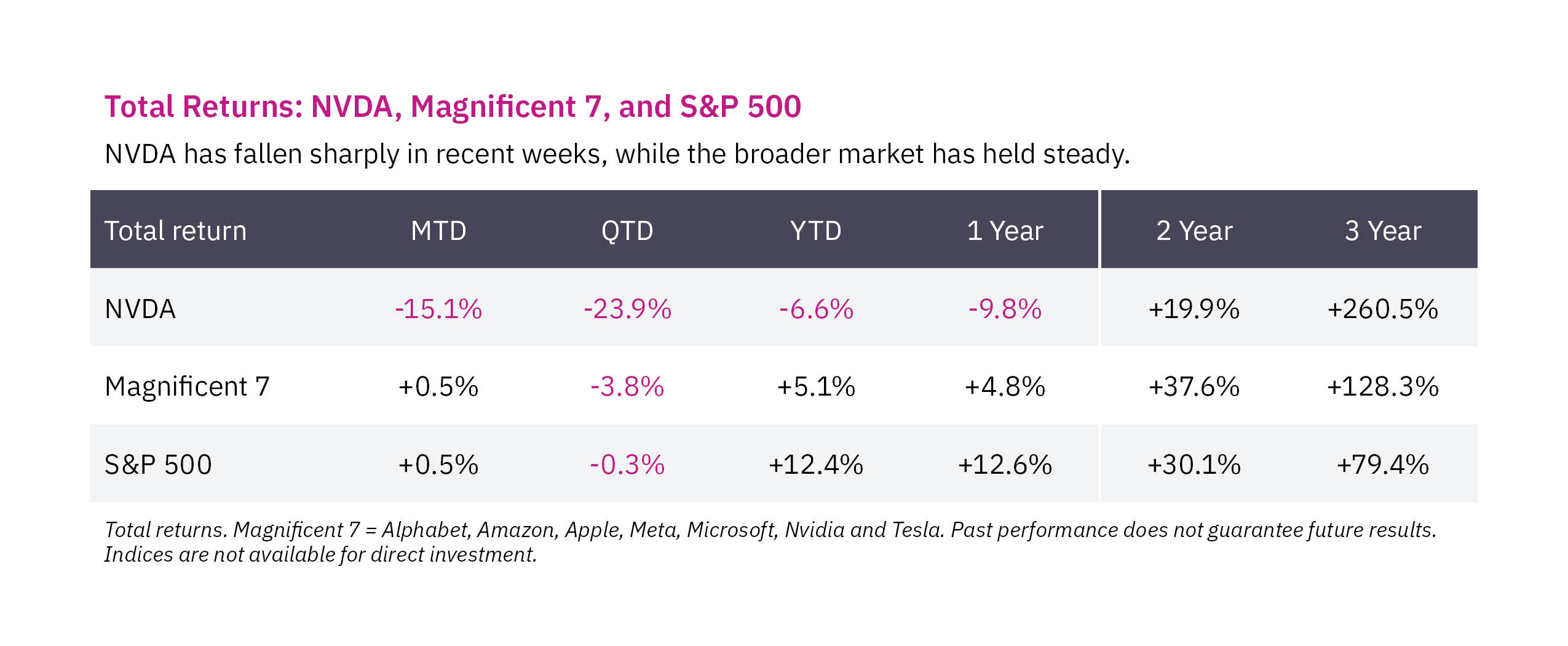
The data tells a reassuring story about the value of diversification. Total returns as of Nov. 11, 2026:
- The Magnificent 7 were up 5% year-to-date
- The remaining 493 S&P 500 companies were up 15% year-to-date
- The S&P 500 overall was up 11% year-to-date



Earnings growth tells a similar story:
- The Mag 7 has delivered 55% year-over-year earnings growth
- The remaining S&P 493 companies have delivered 26% year-over-year earnings growth
The broad market has been doing its job. While a handful of large companies have captured headlines, the rest of the market has been quietly delivering strong returns and earnings growth. That is diversification in action.
The bottom line
A concentrated stock position can be a source of pride, especially when it represents years of hard work or a well-timed investment. But it also carries a specific kind of risk — one that diversification is designed to manage. When a single company’s stock drops on unexpected news, the best response is usually the simplest one: pause, keep the news in perspective, and let your diversified portfolio do what it was designed to do.
If you have questions about your exposure to Nvidia or any concentrated stock position, talk to your wealth advisor.
A planned conversation is always more productive than a reaction to a headline.

FAQs
-
A concentrated stock position is when a single stock makes up a large percentage of your overall portfolio. There is no universal threshold, but many advisors consider a position concentrated when it represents more than 10% to 15% of your investable assets. The risk is that a single company’s performance — good or bad — has an outsized effect on your financial plan.
-
Company-specific risk, also called unsystematic risk, is the risk that comes from holding a single company’s stock. It includes events like leadership changes, product failures, lawsuits, or regulatory actions that affect one company but not the broader market. Diversification is the primary tool for reducing this type of risk, because investors aren’t reliably compensated for bearing it.
-
A sudden stock decline is rarely the best time to make large portfolio decisions. The market is still processing the news, and prices can swing sharply in both directions. A better approach is to pause, assess your overall exposure to the stock, and have a planned conversation with your wealth advisor about whether your concentrated stock position aligns with your long-term goals.
-
There are several strategies for reducing concentration in a tax-aware way, including staged selling over multiple years, tax-loss harvesting to offset gains, direct indexing, exchange funds, and charitable giving strategies. The right approach depends on your cost basis, tax bracket, and overall financial picture. A wealth advisor can help you build a plan that coordinates investment and tax considerations.
-
Long-term research shows that most individual stocks underperform the broader market over time. A diversified portfolio spreads risk across many companies, sectors, and countries, reducing the impact of any single company’s troubles. While concentrated positions can produce strong returns when a company performs well, they also expose you to losses that diversified portfolios are designed to minimize.
-
The Magnificent 7 — Apple, Microsoft, Amazon, Alphabet, Meta, Nvidia, and Tesla — have dominated market headlines in recent years. But the remaining 493 companies in the S&P 500 have been delivering strong returns and earnings growth of their own. As of November 2026, the S&P 493 was outpacing the Magnificent 7 on a year-to-date basis, a reminder that broad market exposure captures growth wherever it occurs.
All expressions of opinion reflect the judgment of the author as of the date of publication and are subject to change. Some of the research and ratings shown in this presentation come from third parties that are not affiliated with Mercer Advisors. The information is believed to be accurate but is not guaranteed or warranted by Mercer Advisors. Content, research, tools and stock or option symbols are for educational and illustrative purposes only and do not imply a recommendation or solicitation to buy or sell a particular security or to engage in any particular investment strategy. All investing involves risk, including the possible loss of principal. Past performance is not a guarantee of future results. Diversification does not ensure a profit or guarantee against loss.
For financial planning advice specific to your circumstances, talk to a qualified professional at Mercer Advisors.