
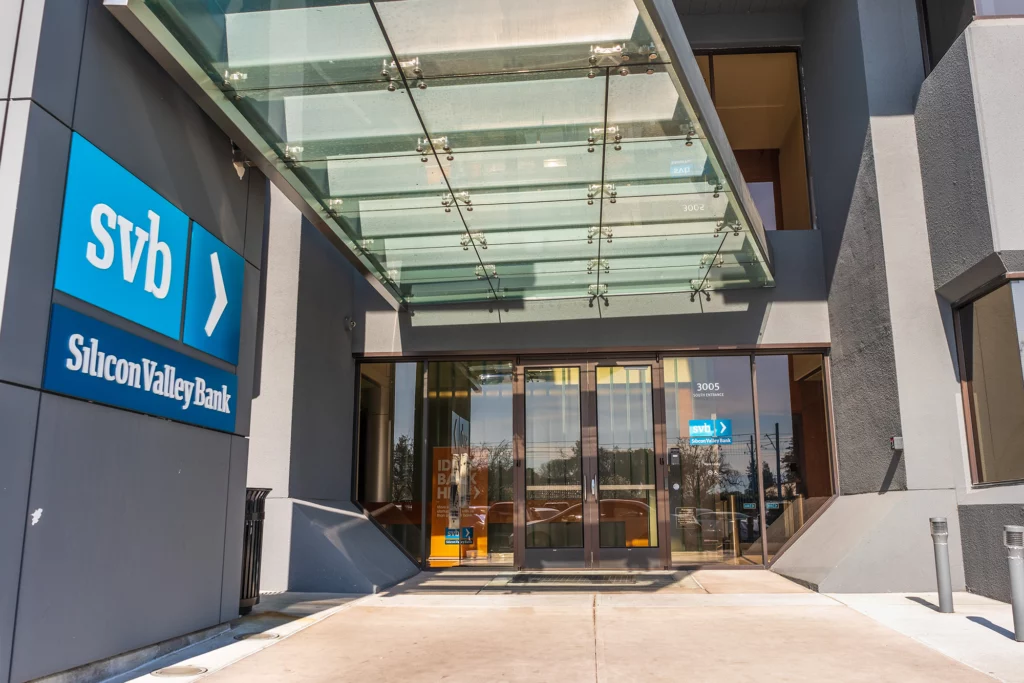
What is Silicon Valley Bank?
Silicon Valley Bank (“SVB”) specialized in providing banking services to technology and healthcare start-ups. It provided financing to almost half of US venture-backed technology and health care companies and over 70% of US venture capital funds.1 Most of SVB’s clients were early-stage companies and funds that relied on SVB for both lending (e.g., business loans) and cash management services (e.g., checking accounts).
Why did SVB fail?
SVB experienced a classic run on the bank. Several forces came together to push it into insolvency:
- Higher interest rates. The Federal Reserve has been aggressively raising interest rates for nearly a year now to combat high inflation. Those higher borrowing costs have become a major headwind for start-ups and other early-stage companies, significantly compromising their ability to finance their businesses.
- Erosion of bank balance sheets. Higher interest rates have significantly eroded the value of long-term bonds that SVB and other banks hold on their balance sheets, severely impacting banks’ liquidity and, therefore, their ability to raise cash to meet redemption requests. Over the past 15 years, while rates were at or near historic lows, many banks were forced to invest heavily in longer term bonds to capture yield—precisely the type of bonds that were hit hardest over the past year as rates rose.
- Start-ups withdraw their cash. As investor appetite for early-stage firms declined over the past year, portfolio companies have needed to draw more heavily on their cash held by SVB to make payroll and finance their business activities. Additionally, higher interest rates paid on excess cash at competing institutions also added to demand for withdrawals from SVB.
- SVB failure to raise needed capital. To meet redemption requests, on Wednesday SVB was forced to sell $21 billion in US treasuries from its bond portfolio, forcing SVB to recognize a staggering $1.8 billion loss; a loss that it needed to fill through a capital raise. To do so, SVB announced on Thursday that it would sell $2.25 billion in common and preferred equity. However, by Friday morning it became clear that SVB would be unable to raise additional capital, prompting the FDIC to shut down the bank later on Friday and force it into receivership.
What is Mercer Advisors’ exposure to Silicon Valley Bank?
Our direct exposure to SVB in our standard 100% equity portfolio is approximately one basis point (~0.01%). Our direct exposure to regional banks, beyond just Silicon Valley Bank, is approximately 0.63% of our standard equity portfolio. For a portfolio with a typical 60/40 portfolio, that works out to 0.006% exposure to SVB and a 0.38% exposure to regional banks as an industry.2
However, when we take a broader view, there are sure to be second order effects emanating from the failure of SVB. Those knock on effects will likely fall hardest on the venture capital community and their underlying portfolio companies. According to Mercer Consulting (not affiliated with Mercer Advisors), over 70% of US venture funds relied on SVB for lending and banking services. The disappearance of such a large, systemically important bank from the venture capital ecosystem will likely result in mark downs in valuations for underlying portfolio companies and higher financing costs for venture funds and portfolio companies alike going forward.
What’s next?
The issues with several regional banks aside, the US banking system appears to be well-capitalized. The collective thinking is that the issues impacting SVB and other regional banks are unlikely to impact the broader economy or spread to larger banks. We generally agree with this assessment.
That said, the dramatic developments of the past few days make it clear that certain corners of the US banking system are under significant stress. The Fed’s rate hikes are clearly having unintended consequences on other areas of the US economy. As a result, there is an increasing probability that the Fed will pause future planned rate hikes at next week’s FOMC meeting until it has more information on the health of US banks and the economy. Additionally, futures markets are currently pricing in interest rate cuts beginning in July 2023—with a target implied policy rate of 3.75% by the end of 2023 (down from a current rate of 4.75%).3
Closing Thoughts
Having navigated multiple market crises over the past 25 years, I’ve learned several important lessons that should serve us well in the current environment.
First, the best advice in times of turmoil is to simply hit the pause button. The worst thing we can do is overreact and make long-term decisions based on short-term news. There is real wisdom in putting some distance between stimulus and response.
Second, we’ve planned for this. Great financial planning is, ironically, ultimately about preparing for when things don’t go as planned. Things like emergency reserves, portfolio diversification, and regularly revisiting our risk tolerance and liquidity needs are all about managing the reality that the future is ultimately unknowable. Planning prepares us for when things don’t go as planned.
Finally, every crisis has a beginning, a middle, and an end. This one too shall pass. The past 25 years have seen a plethora of market challenges. Remember the dot-com implosion of 2000? The contested presidential election of 2000? The terror strikes of 9/11? The accounting scandals at Enron, WorldCom, and others? The financial crisis of 2008? The US downgrade of 2011? The Covid-induced market selloff of March 2020? The presidential election of 2020? Markets overcame all of them and more. There’s no reason to think now should be any different.
If you should have any questions, we encourage you to contact your wealth advisor directly.